


The Guedel stages of anaesthesia are a clinical classification of the depth of inhalational anaesthesia based on observable physiological signs including respiration, eye movement, pupil size, eyelid reflexes, swallowing and vomiting.
The system evolved from Arthur Ernest Guedel’s experience using ether anaesthesia during the First World War. In dealing with a large number of casualties and inexperienced personnel, Guedel devised a simple visual method to assess anaesthetic depth and impending danger. He needed signs that could be “readily grasped by the uninitiated” and assessed during his brief supervisory visits.
Francis Plomley and John Snow had previously described staged progression of ether anaesthesia in 1847. Guedel’s contribution was to correlate observable clinical signs with anaesthetic depth and subdivide Stage III, surgical anaesthesia, into four planes.
The classification comprised four stages:
- Stage I – Analgesia: from commencement of induction to loss of consciousness.
- Stage II – Delirium or excitement: from loss of consciousness to establishment of regular automatic respiration.
- Stage III – Surgical anaesthesia: divided into four planes of progressively increasing depth.
- Stage IV – Respiratory paralysis: from central respiratory arrest to cardiovascular collapse and death.
Historical development
1847 – On January 30, Francis Plomley published Operations upon the eye in which he described three stages or degrees of etherisation. An initial pleasurable intoxication, a second stage with preserved consciousness but diminished concern for pain, and a third stage of profound intoxication and insensibility suitable for surgery.
1847 – John Snow published On the Inhalation of the Vapour of Ether in surgical operations and divided etherisation into five stages or degrees. Snow referred to Plomley’s earlier three-stage description and related it to his own expanded scheme. He acknowledged that the divisions were approximate and merged gradually into one another.
1917–1918 – During service with the American Expeditionary Forces in France, Arthur Ernest Guedel faced a shortage of trained anaesthesia personnel. Nurses, enlisted men and other inexperienced staff were required to administer ether.
Guedel developed a visual teaching chart of physical signs and danger signals that could be learnt rapidly and checked during his motorcycle rounds between base hospitals. The wartime observations formed the foundation of his later classification.
1919 – After returning from France, Guedel presented his system on several occasions:
- April – Indianapolis Medical Society
- September – Indiana State Medical Association
- September 15–17 – Sixth Annual Meeting of the Interstate Association of Anesthetists in Cincinnati
The emphasis was on providing a practical method of maintaining lighter and more even ether anaesthesia while recognising excessive depth.
1920 – Guedel published Third stage ether anaesthesia: a sub-classification regarding the significance of the position and movements of the eyeball. The key innovation was subdivision of Stage III (surgical anaesthesia) into four strata.
Guedel correlated depth with respiratory pattern, eyeball activity, pupil size and laryngeal movement. Eye position and movement were given particular importance because they provided a continuously visible sign of anaesthetic depth.
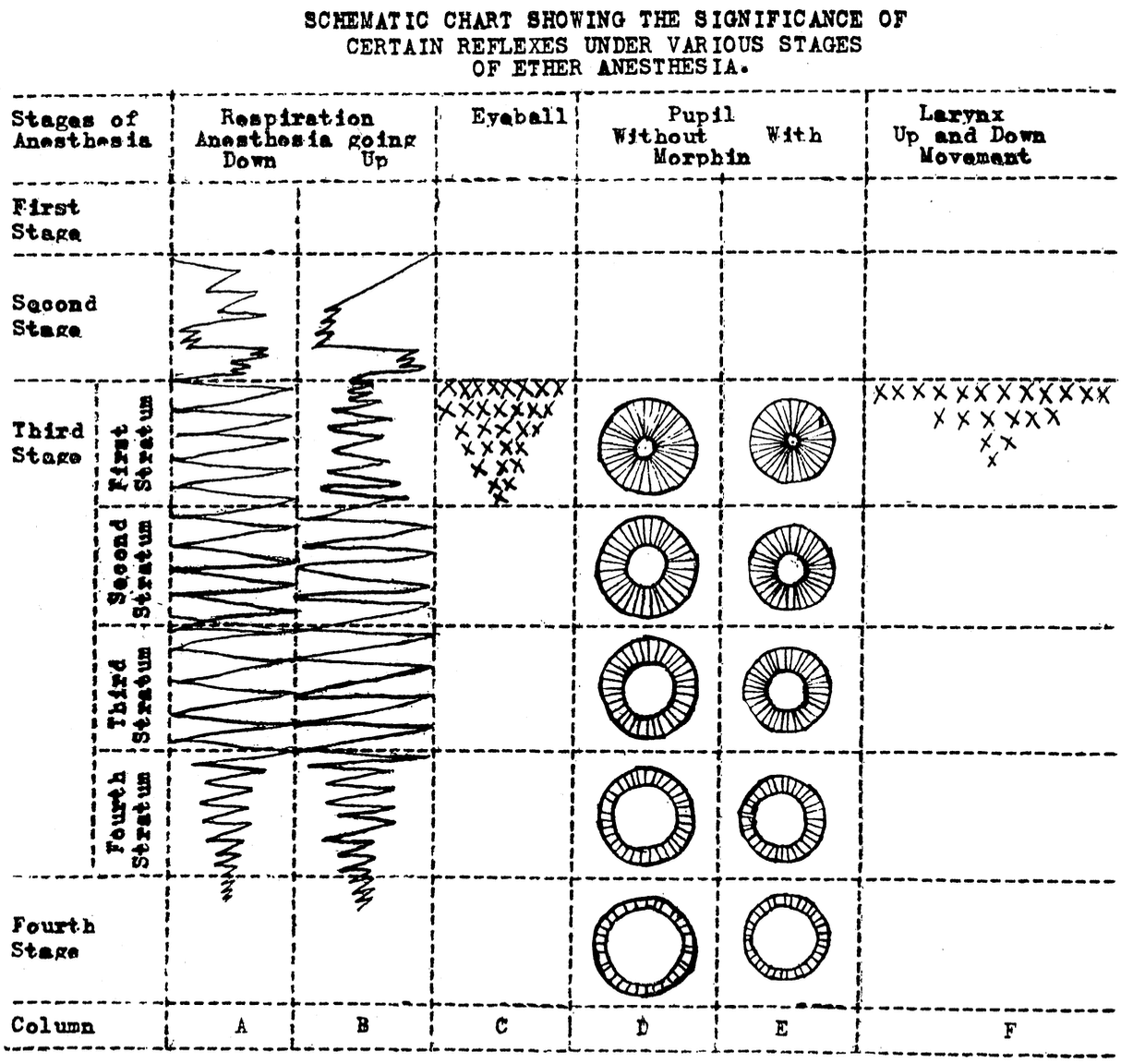
1925 – Albert H. Miller described Ascending respiratory paralysis under general anesthesia. He described a progressive sequence of respiratory patterns with increasing anaesthetic depth:
mixed or usual → delayed thoracic → abdominal → exaggerated abdominal respiration.
Miller attributed this progression to ascending paralysis of the respiratory muscles, with the thoracic muscles affected before the diaphragm. As anaesthesia deepened, costal movement progressively diminished until respiration became predominantly or entirely diaphragmatic. Exaggerated abdominal respiration indicated profound anaesthesia.
Miller proposed respiratory pattern as a practical clinical indicator of anaesthetic depth, complementary to Guedel’s existing ocular signs.
1926 – Ralph M. Waters published Ether Anesthesia. Relation of the Plane of Anesthesia to (1) Circulatory Depression arid (2) Surgical Technique based on a paper presented in April 1925.
Waters combined Miller’s respiratory observations with Guedel’s four planes of Stage III. He proposed that the point at which thoracic breathing ceased should mark the transition from Guedel’s second to third plane.
Waters argued that deeper planes, with loss of thoracic respiratory movement, placed greater strain on the circulation and could worsen rather than improve operative conditions. He therefore favoured the lighter first and second planes of surgical anaesthesia whenever possible.
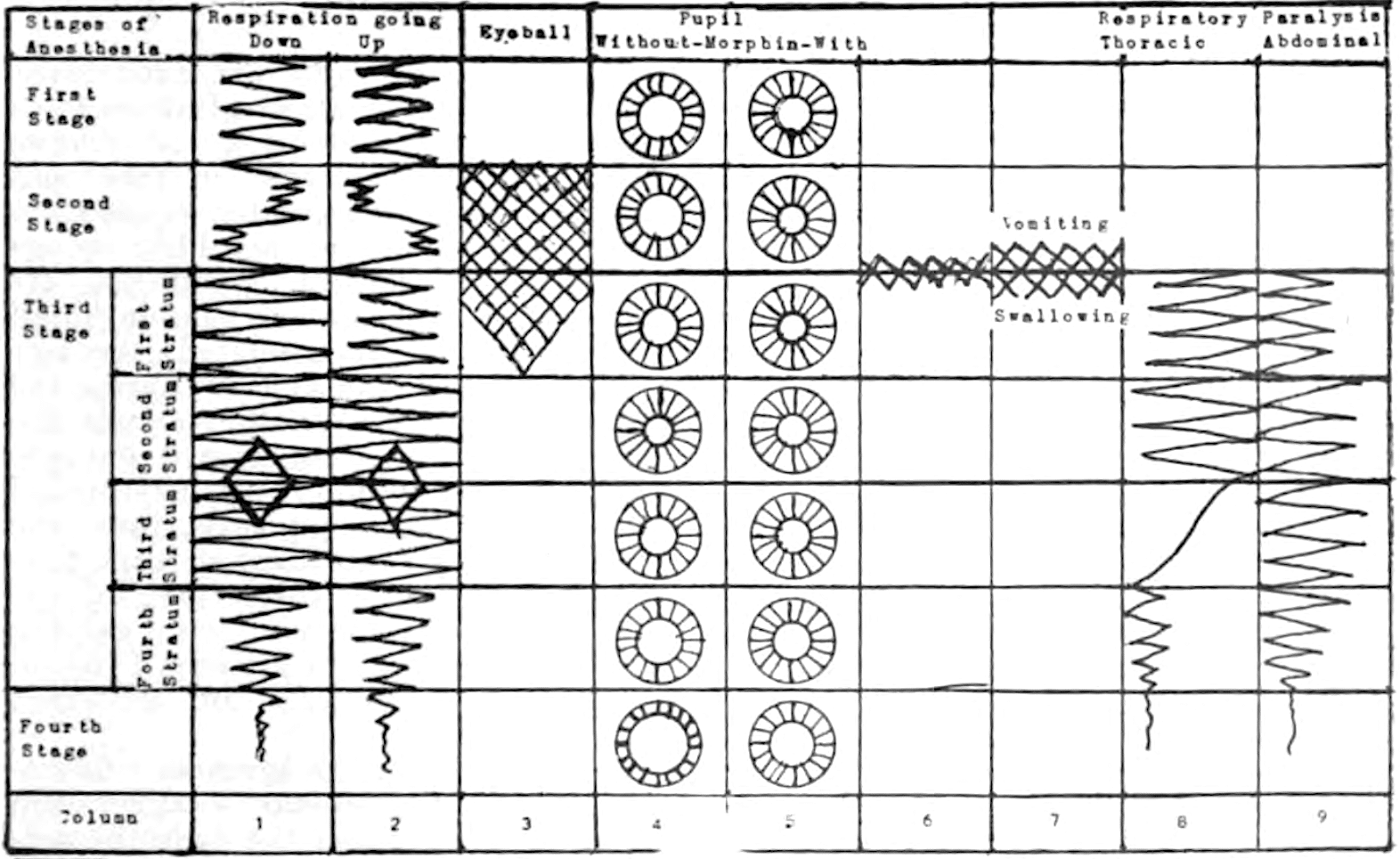
His created a chart provided which bridged Guedel’s 1920 ocular classification and the respiratory components incorporated into Guedel’s revised 1927 scheme.
1927 – Guedel published Stages of Anesthesia and a Re-classification of the signs of Anesthesia and retained the four stages and four subdivisions of Stage III. The revised chart incorporated the work of Miller on ascending respiratory paralysis and Waters observations on thoracic and abdominal respiration. The chart now integrated:
- respiration during deepening and lightening anaesthesia
- eyeball movement
- pupillary response with and without morphine
- swallowing and vomiting
- progressive thoracic and abdominal respiratory paralysis.
1937 – Guedel consolidated the system in Inhalation Anesthesia: A Fundamental Guide and retained the four-stage framework and four planes of Stage III. He revised the chart to incorporate Miller’s ascending respiratory paralysis and Waters’ proposed relationship between thoracic respiration and the boundaries of the surgical planes.
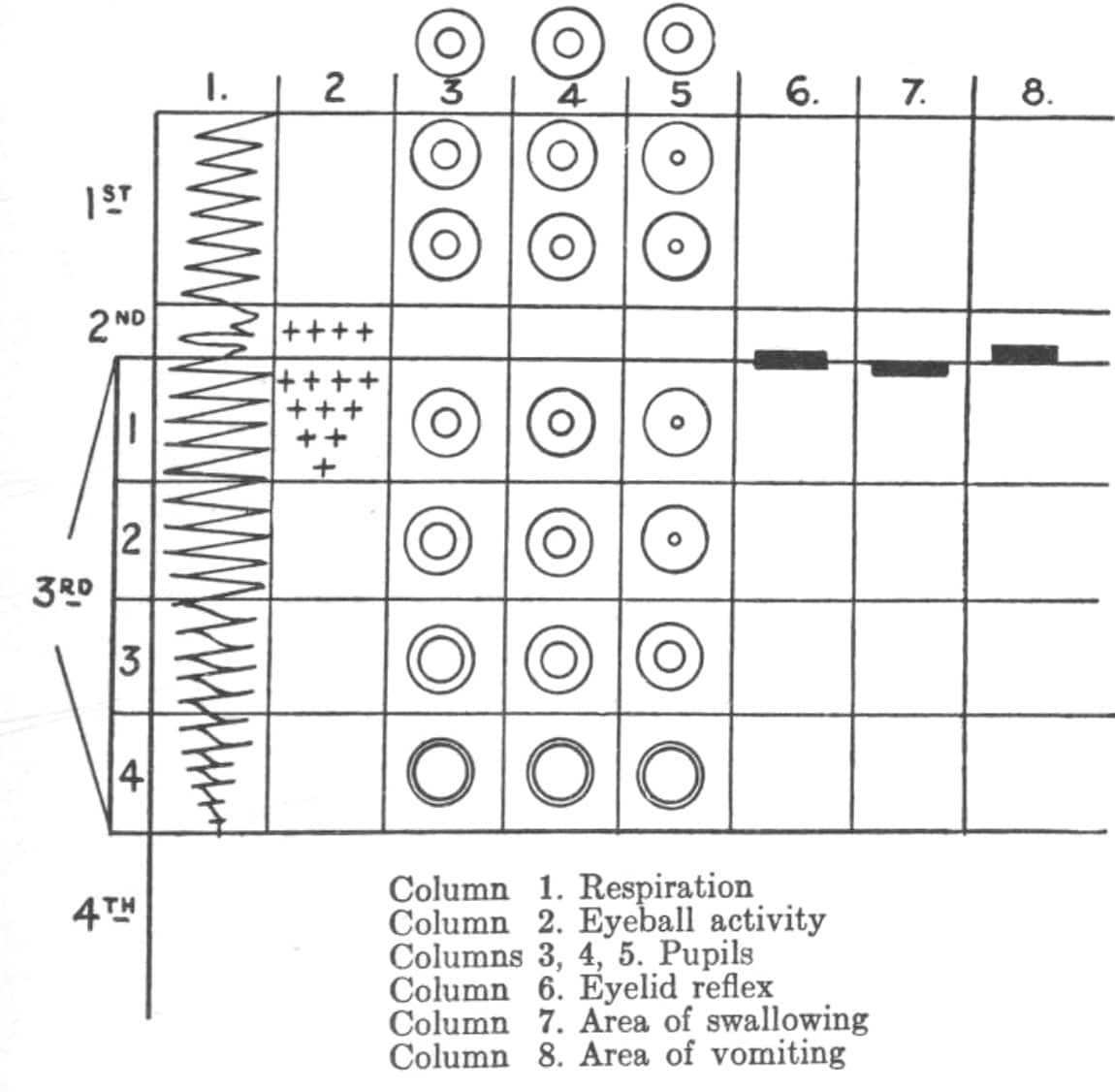
Guedel stated that the signs were clinical guides rather than absolute physiological boundaries. He estimated that anaesthetic depth could be determined correctly from the chart in 90% of cases, warning that “no set of signs can be constant.”
Eponymythology
The Guedel stages were not the first classification of anaesthetic depth. Plomley described three stages of etherisation in January 1847, and Snow described five stageslater the same year.
Guedel initially introduced an four-stage system in 1920 with subdivision of the recognised third or surgical stage. He used clinical signs to distinguish progressively deeper levels of anaesthesia.
In 1927 Guedel revised the stages following work by Miller and Waters. The eponymous term Guedel stages of anaesthesia refers most accurately to Guedel’s refinement, integration and graphical teaching system.
Associated Persons
- Francis Plomley (1806-1861)
- John Snow (1813-1858)
- Albert Heircy Miller (1872–1959)
- Ralph Milton Waters (1883-1979
- Arthur Ernest Guedel (1883-1956)
Alternative names
- Guedel classification
- Guedel stages
- Guedel stages of anaesthesia
- Guedel signs and stages of anaesthesia
References
Historical references
- Plomley F. Operations upon the eye. Lancet 1847; 49(1222): 134-135
- Snow J. On the Inhalation of the Vapour of Ether in surgical operations; containing a description of the various stages of etherization, and a statement of the result of nearly eighty operations. 1847
- Guedel AE. A Sub-classification of Third Stage Ether Anesthesia. Bulletin of the National Anesthesia Research Society. 1920; No. 3.
- Guedel AE. Third stage ether anaesthesia: a sub-classification regarding the significance of the position and movements of the eyeball. Am. J. Surg. (Anesth Suppl.). 1920; 34(4): 53–57.
- Miller AH. Ascending respiratory paralysis under general anesthesia. JAMA 1925;84;(3):201-202.
- Waters RM. Ether Anesthesia. Relation of the Plane of Anesthesia to (1) Circulatory Depression arid (2) Surgical Technique. Current researches in anesthesia and analgesia, 1926; 5(1): 42-43
- Guedel AE. Stages of Anesthesia and a Re-classification of the signs of Anesthesia. Current researches in anesthesia and analgesia, 1927; 6(4): 157-162
- Guedel AE. Inhalation anesthesia – A fundamental guide. Macmillan. 1937: 21-40
eponymictionary
the names behind the name

MB ChB, Edinburgh Medical school. F1/F2 in Bath, now in Australia, Perth preparing for a career in Emergency medicine. I have an interest in wilderness medicine and women’s health, but haven’t fully found my niche interest yet.

BA MA (Oxon) MBChB (Edin) FACEM FFSEM. Emergency physician, Sir Charles Gairdner Hospital. Passion for rugby, medical history, medical education, and asynchronous learning #FOAMed evangelist. Editor-in-Chief and Webmaster of Life in the Fast lane, LITFL | On Call 4e| Eponyms | Books | Horology |