


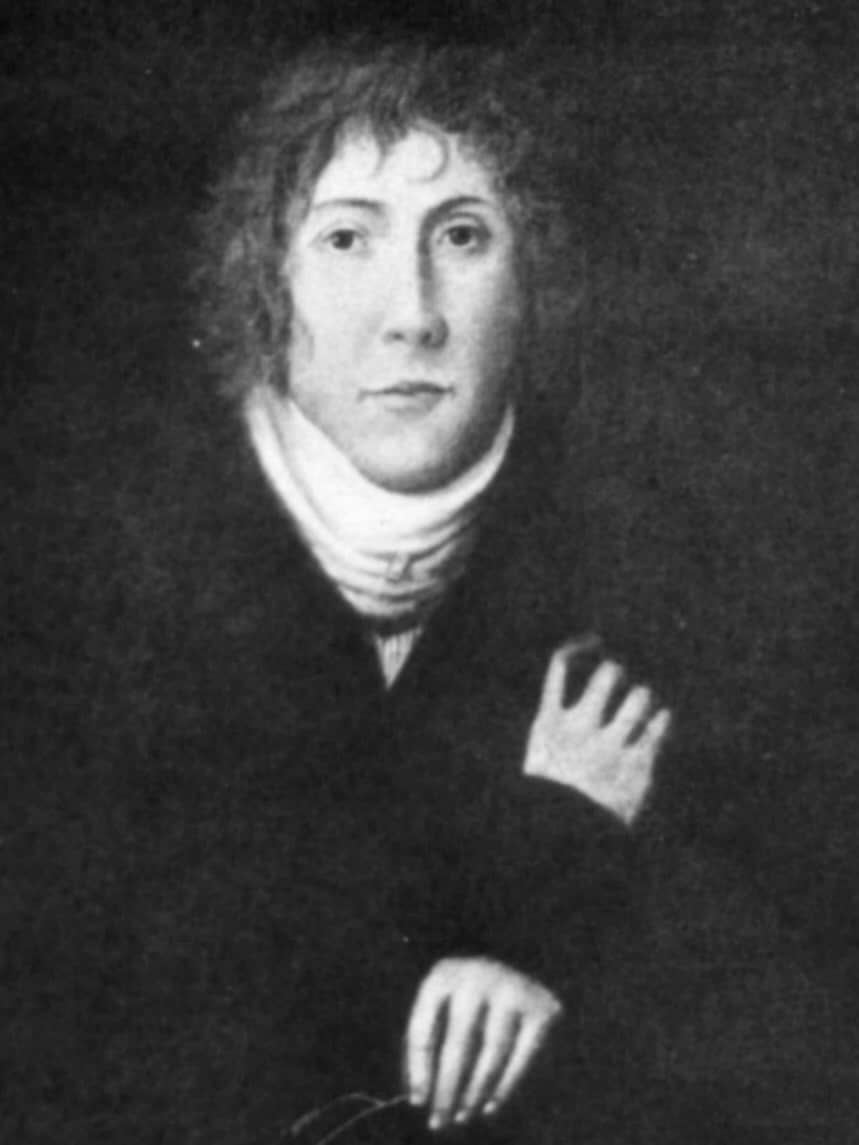
Philipp Bozzini (1773–1809) was a German physician and obstetrician
Educated in Mainz and Jena, Bozzini developed an interest in applying mechanical and optical principles to problems of clinical examination. His career encompassed military medicine, private practice and public medical service in Frankfurt am Main.
Bozzini proposed that visual observation could improve anatomical understanding, diagnosis and operative precision. In 1804 he designed the Lichtleiter (light conductor), announced in 1805 and described in detail in publications of 1806–1807.
Bozzini’s invention attracted both favourable assessments and criticism but was not widely adopted during his lifetime. His Lichtleiter is now recognised as an important early development in endoscopy and the optical history of laryngoscopy.
Biographical Timeline
- Born on May 25, 1773 in Mainz, Germany. His father, Nicolaus Maria Bozzini de Bozza, came from an Italian family that had settled in Mainz following his involvement in a fatal duel.
- 1794 – Medical studies at the University of Jena, having begun his education in Mainz under Samuel Thomas von Sömmerring (1755-1830). In Jena, he studied under Christian Gottfried Gruner (1744–1815) and Christoph Wilhelm Hufeland (1762–1836).
- 1796 – Awarded his doctorate in medicine at Mainz on June 12. Appointed extraordinary assessor of the medical faculty on July 13 and licensed to practise medicine on September 21. Travelled to France and the Netherlands for further clinical experience.
- 1798 – Married Margarete Reck, daughter of the Mainz forestry councillor Franz Reck. They had three children.
- 1799–1802 – Served as a military physician in the Austrian imperial army during the War of the Second Coalition. Directed a 120-bed field hospital in Mainz and gained the support of Archduke Charles of Austria (1771–1847).
- 1803 – Granted citizenship of Frankfurt am Main on May 10, following repeated applications, medical examinations and intervention by Archduke Charles. Established a private medical practice in Frankfurt.
- 1804 – Concentrated increasingly on developing the Lichtleiter, an instrument intended to illuminate and permit observation of internal body cavities. The precise date of its earliest construction remains uncertain.
- 1805 – Announced the Lichtleiter in the Kaiserlich privilegirter Reichs-Anzeiger, no. 36, on February 7.
- 1806 – Published his first detailed scientific account of the Lichtleiter in Hufeland’s Journal der practischen Arzneykunde und Wundarzneykunst, outlining the principles of internal illumination, reflected observation and interchangeable specula.
- 1807 – Published Der Lichtleiter in Weimar, providing an expanded description of the apparatus, its intended clinical applications and four engraved plates. The instrument underwent official evaluation in Vienna.
- 1808 – Appointed Physicus extraordinarius in Frankfurt in May, following the support of Karl Theodor von Dalberg (1744–1817). His responsibilities included medical care for surrounding rural communities and patients affected by epidemics.
- Died in Frankfurt on April 4, 1809 aged 35 during an epidemic fever outbreak.
Medical Eponyms
Bozzini Lichtleiter (1805)
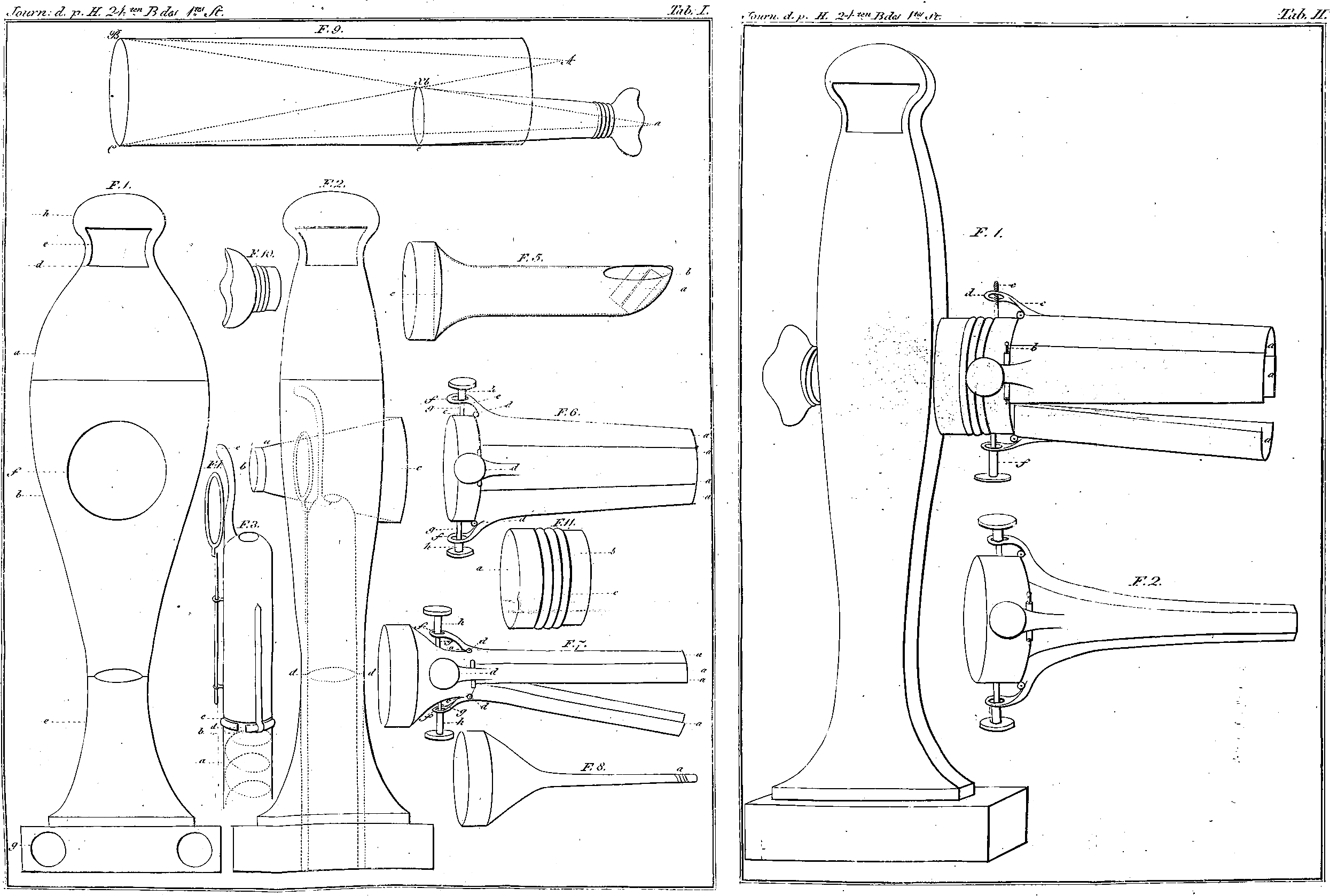
The Bozzini Lichtleiter (light conductor) was an early endoscopic instrument designed to illuminate and examine internal body cavities. The apparatus combined a candle-powered light source, separate illumination and viewing channels, and interchangeable metal specula adapted to different anatomical openings.
Bozzini announced his invention in 1805, published its optical principles and technical design in 1806, and provided an expanded illustrated description in 1807. The Lichtleiter allowed light to be directed into body cavities and reflected images returned to the observer. The instrument represented an important development in the history of endoscopy and internal visual examination.
Major Publications
- Bozzini P. Künste, Manufacturen und Fabriken. Kaiserlich privilegirter Reichs-Anzeiger, 1805; 36: 465.
- Bozzini P. Lichtleiter, eine Erfindung zur Anschauung innerer Teile und Krankheiten, nebst der Abbildung. Journal der practischen Arzneykunde und Wundarzneykunst. 1806; 24 : 107-124.
- Bozzini P. Der Lichtleiter oder die Beschreibung einer einfachen Vorrichtung und ihrer Anwendung zur Erleuchtung innerer Höhlen und Zwischenräume des lebenden animalischen Körpers. 1807
- Bozzini P. Ueber die den Gelehrten Oesterreichs und des Auslandes von der medicinischen Facultät zu Wien gemachten Bemerkungen über meinen Lichtleiter. Allgemeiner Anzeiger der Deutschen, 1807; 84: 857-866
References
Biography
- Feyerlein FS. Nachruhm des Verdienstes. National-Zeitung der Deutschen. 11 May 1809; 19: 384–388
- Stricker. Bozzini, Philipp. Allgemeine Deutsche Biographie 3. 1876: 227
- Mann G. Altes Neues zu Philipp Bozzini (1773-1809). Medizinhist J. 1972;7:201-3.
- Bozzini, Philipp. Frankfurter Personenlexikon
Eponymous terms
- Rathert P, Lutzeyer W, Goodwin WE. Philipp Bozzini (1773-1809) and the Lichtleiter. Urology. 1974 Jan;3(1):113-8.
- Bush RB, Leonhardt H, Bush IV, Landes RR. Dr. Bozzini’s Lichtleiter. A translation of his original article (1806). Urology. 1974 Jan;3(1):119-23
- Kraft W, Füssmann AK. 190 Jahre klinische Endoskopie: Philipp Bozzini, ein fast vergessener Pionier. Tierarztl Prax. 1995 Jun;23(3):231-5.
- Hausmann H. Philipp B. Bozzini (1773-1809). Zum 175. Todestag des Begründers der urologischen Endoskopie. Z Urol Nephrol. 1984 Dec;77(12):729-34.
- Morgenstern L. The 200th anniversary of the first endoscope: Philipp Bozzini (1773-1809). Surg Innov. 2005 Jun;12(2):105-6.
- Reuter M. Philipp Bozzini (1773-1809): Der endoskopische Idealist. Urologe A. 2006 Sep;45(9):1084-8, 1090-1.
- Verger-Kuhnke AB, Reuter MA, Beccaria ML. La biografía de philipp Bozzini (1773-1809) un idealista de la endoscopia. Actas Urol Esp. 2007 May;31(5):437-44.
- Ramai D, Zakhia K, Etienne D, Reddy M. Philipp Bozzini (1773-1809): The earliest description of endoscopy. J Med Biogr. 2018 May;26(2):137-141.
Eponym
the person behind the name

BA MA (Oxon) MBChB (Edin) FACEM FFSEM. Emergency physician, Sir Charles Gairdner Hospital. Passion for rugby, medical history, medical education, and asynchronous learning #FOAMed evangelist. Editor-in-Chief and Webmaster of Life in the Fast lane, LITFL | On Call 4e| Eponyms | Books | Horology |