


Dietrich Tönnis

Dietrich Tönnis (1927-2010) was a German paediatric orthopaedic surgeon
Tönnis was a leading authority on developmental dysplasia of the hip. He combined radiographic measurement, long-term outcome studies and reconstructive surgery to improve the diagnosis and treatment of hip dysplasia from infancy through adulthood.
Tönnis is associated with the Tönnis angle, Tönnis classification of DDH, Tönnis classification of hip osteoarthritis, and the Tönnis triple pelvic osteotomy. He also developed quantitative methods including the hip value (Hüftwert), studied treatment-related ischaemic necrosis of the femoral head, and investigated the relationship between acetabular and femoral version and osteoarthritis. His 1987 textbook Congenital Dysplasia and Dislocation of the Hip in Children and Adults became an international reference on the subject.
Biographical Timeline
- Born in August 10, 1927 in Würzburg, Germany, son of neurosurgeon Wilhelm Tönnis.
- 1947–1953 – Studied medicine at Münster, Freiburg, Cologne and Munich and completed the medical state examination in Munich.
- 1954–1955 – Undertook a one-year Ventnor Foundation internship in Long Branch, New Jersey.
- 1958–1960 – Trained in trauma surgery at Bergmannsheil, Bochum.
- 1960 – Began orthopaedic training under Alfred Nikolaus Witt at the Oskar-Helene-Heim in Berlin, later continuing at the University Orthopaedic Clinic in Munich-Harlaching.
- 1963 – Awarded the Linninger Prize of the German Society for Trauma Surgery.
- 1966 – Completed his Habilitation at the Free University of Berlin. Early research included electromyographic studies of clubfoot, hip dysplasia and other orthopaedic disorders.
- 1968 – With D. Brunken, published a study of 2,294 paediatric hip radiographs examining normal and pathological acetabular roof angles in hip dysplasia.
- 1970 – Appointed head of the Orthopaedic Clinic, Municipal Hospitals Dortmund.
- 1972 – With Busse and Gasteiger, developed the “hip factor” / hip value, a composite radiographic assessment incorporating several measures of hip morphology.
- 1976 – Published “Normal values of the hip joint for the evaluation of X-rays in children and adults”, which helped standardise radiographic assessment of the developing hip and the Tönnis angle.
- 1981 – Collaborated with Henri Bensahel, John Sharrard, Josée Mesquita Montes and Jürgen Baumann in planning the European Paediatric Orthopaedic Society (EPOS).
- 1982 March 13 – Elected to teh first executive board and one of the 13 European surgeons who founded EPOS in Paris, Hôpital Bretonneau
- 1982 The founding meeting was held in Paris on March 13, 1982.
- 1983 – Elected the first Treasurer of EPOS at the second annual meeting in Paris. Served as Treasurer until 1987.
- 1984 – Published Die angeborene Hüftdysplasie und Hüftluxation im Kindes- und Erwachsenenalter, the culmination of years of work on DDH.
- 1987 – English edition published as Congenital Dysplasia and Dislocation of the Hip in Children and Adults.
- 1987 – Co-founded the German Vereinigung für Kinderorthopädie (VKO) with Klaus Parsch, Lutz Jani and Fritz Niethard.
- 1990 – With Storch and Ulbrich, published results of newborn screening for congenital hip dislocation with and without sonography.
- 1992 – Retired from his post as head of the Orthopaedic Clinic in Dortmund.
- 1999 – Became an honorary member of EPOS.
- 2007 – Awarded the EPOS Pro Maximis Meritis medal in Warsaw.
- Died on August 21, 2010 in Dortmund-Syburg, aged 83.
Medical Eponyms
Tönnis angle (1968)
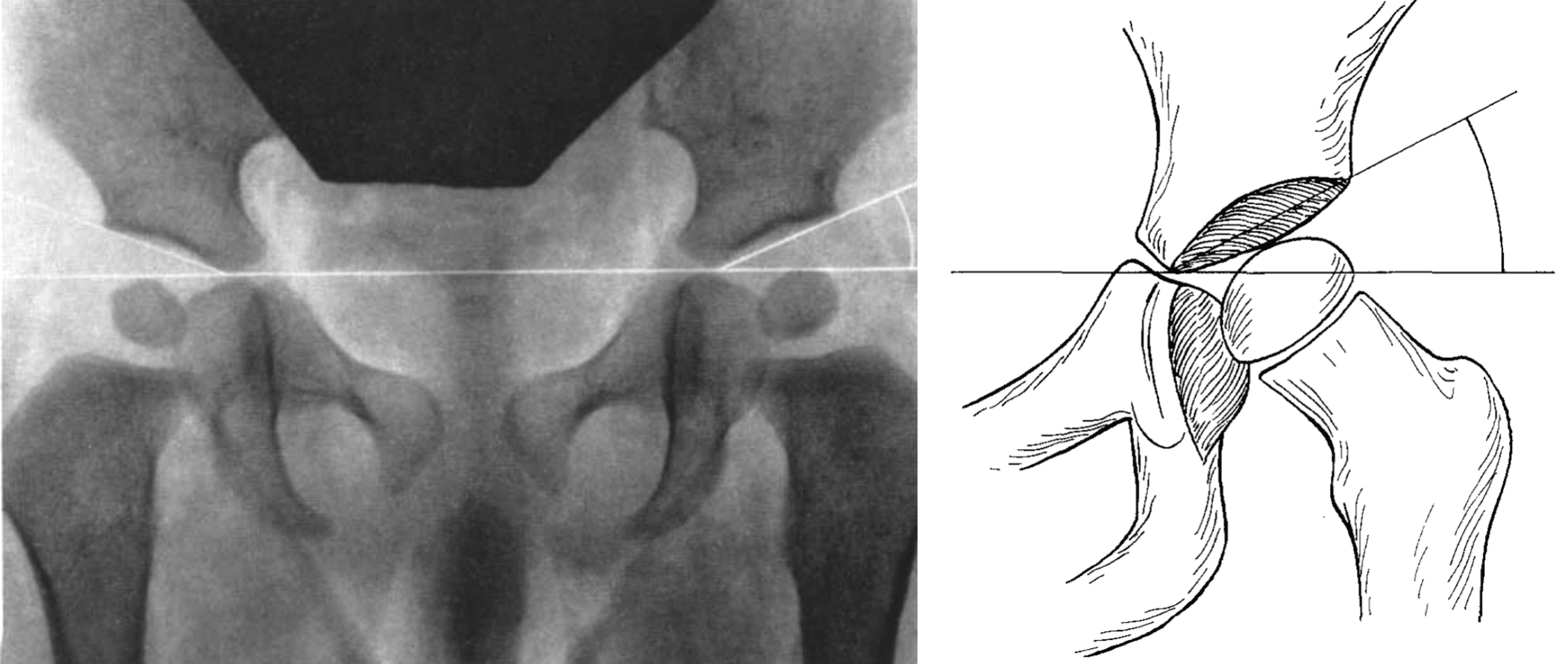
Tönnis angle is an eponymous term for the acetabular roof angle or acetabular index used in radiographic assessment of the developing hip. In 1968 Tönnis and Brunken studied 2,294 paediatric hips, establishing age-related normal ranges and practical limits between normal and pathological acetabular development while examining the effects of pelvic rotation and tilt.
Tönnis measured the angle described by Heinrich Hilgenreiner (1870–1953), and in his 1987 textbook continued to call it the “acetabular index of Hilgenreiner.” His contribution was its systematic standardisation and clinical interpretation.
Tönnis classification of developmental dysplasia of the hip
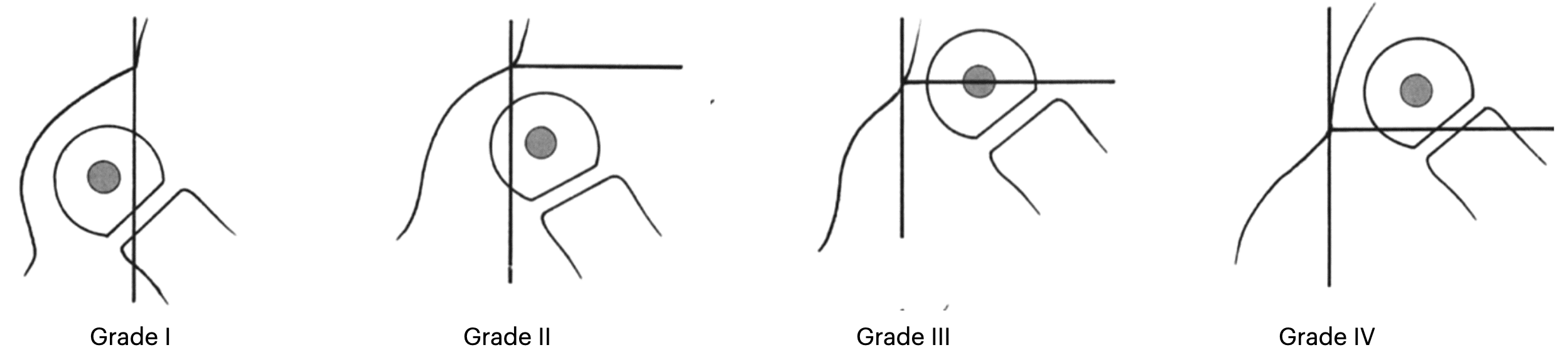
1978 – Tönnis classification of DDH is a four-grade radiographic system commonly known as the Tönnis classification. It grades the severity of hip displacement according to the position of the femoral-head ossific nucleus relative to the Ombrédanne–Perkins line and the superolateral acetabular margin.
The system arose from the Arbeitskreis für Hüftdysplasie / Commission for the Study of Hip Dysplasia of the German Society for Orthopaedics and Traumatology, which required a reproducible radiographic method for retrospective comparison of treatment outcomes. Tönnis and colleagues published the collective work in 1978 and 1982. Tönnis subsequently reproduced the system in his 1984 German and 1987 English monographs, after which it became widely associated with his name.
- Grade I — ossific nucleus medial to the Ombrédanne–Perkins line
- Grade II — lateral to the line but below the superolateral acetabular margin
- Grade III — approximately level with the superolateral acetabular margin
- Grade IV — clearly above the superolateral acetabular margin
Tonnis et al. 1978
The classification depends on a visible femoral-head ossific nucleus. The later IHDI classification addressed this limitation by using the proximal femoral metaphysis as the reference landmark instead.
Tönnis classification of hip osteoarthritis
Tönnis classification of hip osteoarthritis is a radiographic grading system for osteoarthritis of the hip. It is expressed as grades 0–3, from no radiographic osteoarthritis to severe joint-space loss, cyst formation and deformity.
Its origins lie in Tönnis’ quantitative studies of adult hip radiographs in Dortmund during the early 1970s. Work associated with the development of the hip factor divided adult hips according to radiographic degenerative change. Later modification by Tönnis and Heinecke evolved into the grading system of hip osteoarthritis.
Tönnis triple pelvic osteotomy
Tönnis triple pelvic osteotomy (Tönnis osteotomy) is a reconstructive procedure for acetabular dysplasia that permits three-dimensional reorientation of the acetabulum through osteotomies of the ilium, pubis and ischium.
Tönnis developed the operation in the late 1970s, particularly for older children, adolescents and adults in whom simpler acetabular procedures offered insufficient correction. With K. Behrens and F. Tscharani he published his modified technique of the triple pelvic osteotomy in 1981. The operation allowed the acetabular fragment to be rotated to improve femoral-head coverage and correct acetabular inclination.
Tönnis–Kuhlmann classification
The Tönnis–Kuhlmann classification grades ischaemic necrosis of the femoral head following treatment of congenital hip dislocation. Tönnis and G. P. Kuhlmann introduced the system in 1968 while investigating femoral-head necrosis associated with abduction treatment and other conservative methods.
The four grades progress from mild mottling and irregularity of the ossific nucleus (grade 1), through increasing structural damage and fragmentation (grades 2–3), to physeal involvement with growth disturbance (grade 4). Tönnis subsequently used the classification in collective studies comparing treatment methods and the risk of ischaemic necrosis.
Key Medical Contributions
Hip value (Hüftwert)
With J. Busse, W. Gasteiger, R. Brückl and colleagues, Tönnis developed a composite radiographic measure intended to distinguish normal from dysplastic hips. The hip value combined the centre-edge angle of Wiberg, ACM angle of Idelberger and Frank, and MZ distance into a single standardised score.
Subsequent studies used the hip value to assess juvenile dysplasia and as an aid to deciding when corrective surgery should be considered. Brückl and Tönnis examined its value in operative decision-making in juvenile dysplastic hips in Der Hüftwert als Entscheidungshilfe zur Operationsindikation bei der jugendlichen Dysplasiehüfte in 1981.
Prevention of ischaemic necrosis
Tönnis devoted attention to ischaemic necrosis of the femoral head, one of the most serious complications of DDH treatment. His studies examined the relationship between necrosis and the method of reduction, age, severity of dislocation, duration of immobilisation and position of the hip in casts or harnesses.
The German national collaborative data supported treatment in greater flexion with less extreme abduction, rather than the traditional Lorenz position, and encouraged gentler reduction and arthrographic assessment where necessary.
Major Publications
- Tönnis D, Brunken D. Eine Abgrenzung normaler und pathologischer Hüftpfannendachwinkel zur Diagnose der Hüftdysplasie. Auswertungen von 2294 Pfannendachwinkeln kindlicher Hüftgelenke. Arch Orthop Unfallchir. 1968;64(3):197-228.
- Busse J, Gasteiger W, Tönnis D. Eine neue Methode zur röntgenologischen Beurteilung eines Hüftgelenkes–Der Hüftwert. Arch Orthop Unfallchir. 1972;72(1):1-9.
- Tönnis D. Normal values of the hip joint for the evaluation of X-rays in children and adults. Clin Orthop Relat Res. 1976 Sep;(119):39-47.
- Tönnis D. An evaluation of conservative and operative methods in the treatment of congenital hip dislocation. Clin Orthop Relat Res. 1976 Sep;(119):76-88.
- Tönnis D, Behrens K, Tscharani F. A modified technique of the triple pelvic osteotomy: early results. J Pediatr Orthop. 1981;1(3):241-9.
- Brückl R, Tönnis D. Der Hüftwert als Entscheidungshilfe zur Operationsindikation bei der jugendlichen Dysplasiehüfte [The “hip value” as a criterium for the operative treatment of CDH in juveniles (author’s transl)]. Z Orthop Ihre Grenzgeb. 1981 Oct;119(5):486-90.
- Tönnis D. Die angeborene Hüftdysplasie und Hüftluxation im Kindes- und Erwachsenenalter. 1984
- Tönnis D, Legal H, Graf R. Congenital Dysplasia and Dislocation of the Hip in Children and Adults. 1987
- Tönnis D, Storch K, Ulbrich H. Results of newborn screening for CDH with and without sonography and correlation of risk factors. J Pediatr Orthop. 1990 Mar-Apr;10(2):145-52.
- Tönnis D, Heinecke A. Acetabular and femoral anteversion: relationship with osteoarthritis of the hip. J Bone Joint Surg Am. 1999 Dec;81(12):1747-70.
References
Biography
- Krauspe R. Obituary—Dietrich Tönnis. J Child Orthop. 2010 Dec;4(6):505–6.
- Nachruf – In Erinnerung an Dietrich Tönnis. Z Orthop Unfall 2010; 148(6): 626-627
Eponymous terms
- Campbell SE. Radiography of the hip: lines, signs, and patterns of disease. Semin Roentgenol. 2005 Jul;40(3):290-319.
- Yeap PM, Budak MJ. The pelvic radiograph: lines, arcs and stripes. Singapore Med J. 2021 Jul;62(7):333-340.
- Bi AS, Carter C, Price AE, Litrenta J, Karamitopoulos M, Castañeda PG. A history of eponym usage in hip and pelvis radiography part 1: the paediatric hip. Hip Int. 2023 Mar;33(2):136-143.
- Bi AS, Ryan MK, Castañeda PG, Youm T. A history of eponym usage in hip and pelvis radiography part 2: the adult hip. Hip Int. 2023 Mar;33(2):144-151
Eponym
the person behind the name

MB BAO BCh Trinity College Dublin, MSc Clinical Data Analytics University of Galway. Junior doctor in Perth, doctoral researcher in MRI radiomics. Working towards radiology training.

BA MA (Oxon) MBChB (Edin) FACEM FFSEM. Emergency physician, Sir Charles Gairdner Hospital. Passion for rugby, medical history, medical education, and asynchronous learning #FOAMed evangelist. Editor-in-Chief and Webmaster of Life in the Fast lane, LITFL | On Call 4e| Eponyms | Books | Horology |