


The Bozzini Lichtleiter was an early endoscopic instrument developed by Philipp Bozzini to illuminate and examine internal body cavities. It combined a candle-powered light source, reflecting mirrors and interchangeable tubular specula, allowing light to be directed into a cavity while returning a reflected image to the observer.
The Lichtleiter was developed to examine the urinary, reproductive and upper aerodigestive tracts and is recognised as an early precursor of modern endoscopy. Morell Mackenzie highlighted its relevance to the development of laryngoscopy in 1865, although Bozzini did not document successful visualisation of the vocal cords.
History
1805 – German physician Philipp Bozzini (1773–1809) announced his invention of an apparatus for examining the internal cavities of the living body.
The short announcement was published under Künste, Manufacturen und Fabriken in the Kaiserlich privilegirter Reichs-Anzeiger. He described a device capable of examining body cavities through natural or pathological openings, provided they were not obscured by opaque fluids.
Gewisse Ursachen bestimmen mich, die Anzeige von der Erfindung einer einfachen und leicht anwendbaren Vorrichtung zu machen, durch die man in alle innere Höhlen des lebenden animalischen Körpers, die nicht undurchsichtige Flüssigkeiten enthalten, durch physiologische oder pathologische Oeffnungen genau sehen kann. Bozzini 1805
Certain circumstances have prompted me to announce the invention of a simple and easily applied apparatus, by means of which one may see accurately into all the internal cavities of the living animal body that do not contain opaque fluids, through natural or pathological openings. Bozzini 1805
1806 – Bozzini published a detailed description of his Lichtleiter (light conductor) with engraved plates illustrating the instrument and its interchangeable attachments.
The apparatus comprised a vase-shaped housing containing a wax candle maintained at a constant height by a spring-loaded mechanism. Metal tubes directed light into the cavity, while a separate reflection channel returned the illuminated image to the observer. Interchangeable specula were designed for different anatomical openings, including the ear, nose, mouth, urethra, vagina and rectum.
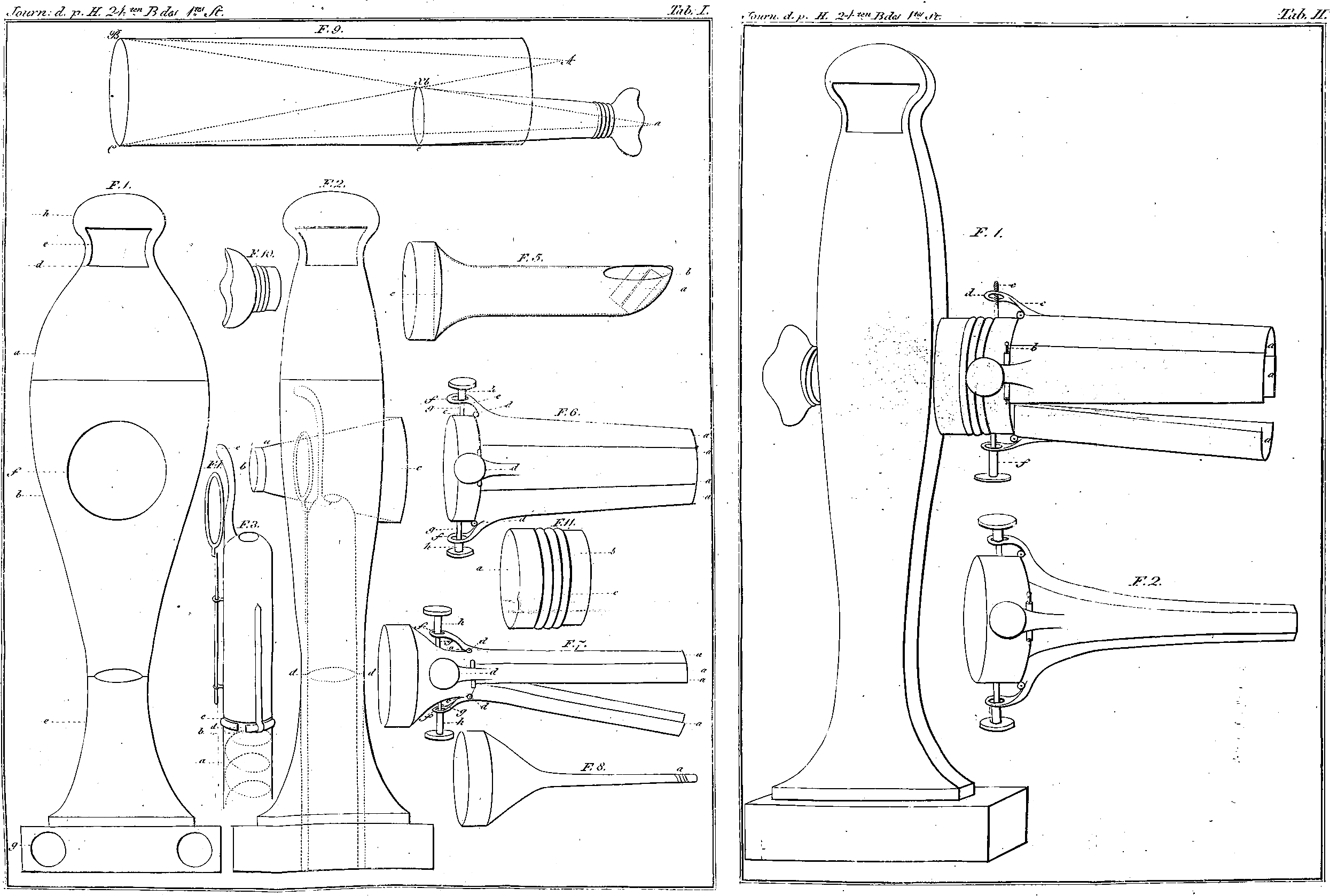
Bozzini described an angled viewing tube (Winkelleitung) incorporating mirrors to illuminate and observe structures beyond the direct line of sight, including the region behind the soft palate.
He defined the fundamental requirements for internal visual examination as:
I. Eine gehörige Menge Lichtstoff in dieselbe zu leiten.
II. Die reflectirte Strahlen desselben auf das Auge zurückzuführen.
I. To direct a sufficient quantity of light into the cavity.
II. To return the reflected light rays to the observer’s eye.
1806–1807 – The Lichtleiter underwent clinical demonstrations and formal evaluation. In 1806, Ludwig Friedrich von Froriep (1779–1847) examined the instrument at his private maternity institution in Halle and reported satisfactory views of the vagina in living patients. In November 1806, the director of the Josephs-Akademie in Vienna, Anton von Beinl (1749–1820), requested an example of Bozzini’s apparatus for official investigation.
On December 9, 1806, the instrument was examined at the Josephinum. Further trials on January 17, 1807 compared the Lichtleiter with a modified version developed by the Academy’s prosector, Johann Georg Ilg (1781–1836).
The Josephinum recognised the originality and potential of Bozzini’s instrument. However its examination described practical limitations such as the restricted illumination and difficulties manipulating the specula. Ilg’s modified Viennese model, demonstrated an improved illumination and viewing system, and was judged easier to operate.
1807 – Bozzini published Der Lichtleiter oder die Beschreibung einer einfachen Vorrichtung und ihrer Anwendung zur Erleuchtung innerer Höhlen und Zwischenräume des lebenden animalischen Körpers.
This monograph outlined the instrument’s construction, optical principles and intended applications. Bozzini described interchangeable rigid and expandable specula, angled viewing attachments and adaptations for examining cavities of different sizes and anatomical configurations.
Bozzini defined the Lichtleiter as a means of observing physiological processes, improving diagnostic accuracy and guiding surgical intervention under direct vision. A technical framework for later endoscopic development.
1807 – The Vienna Medical Faculty questioned the instrument’s usefulness, the limited area visible through its examination tubes and the practical difficulties of its application. Bozzini publicly challenged the unfavourable assessment in Ueber die den Gelehrten Oesterreichs und des Auslandes von der medicinischen Facultät zu Wien gemachten Bemerkungen über meinen Lichtleiter.
Bozzinidisputed the faculty’s technical criticisms and questioned whether its members had adequately examined the instrument stating “Ich glaube aber nicht einmal, daß sie einen Lichtleiter besitzt” [I do not even believe that it possesses a Lichtleiter.]
1865 – British laryngologist Sir Morell Mackenzie (1837-1892) reviewed Bozzini’s contribution in The Use of the Laryngoscope in Diseases of the Throat.
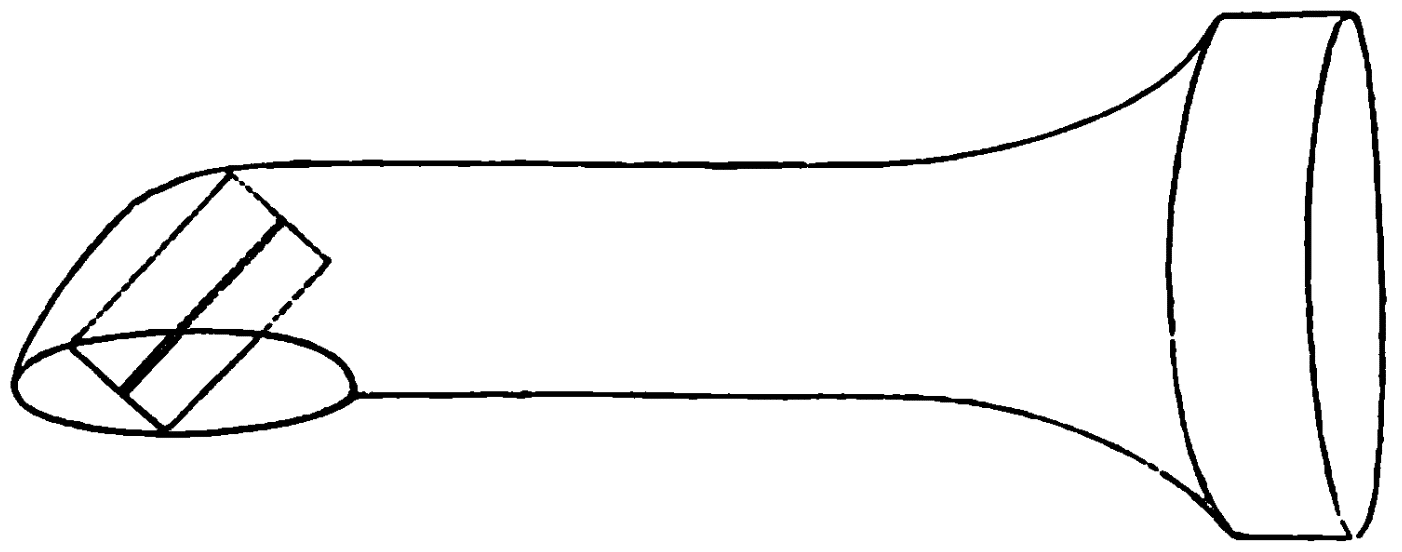
Mackenzie described the candle-powered apparatus and its angled, double-channel speculum calling the apparatus Bozzini’s Laryngeal Speculum. He recognised that Bozzini designed the essential optical requirements of laryngoscopy, although the instrument had not become an established method of examining the larynx.
The elements of laryngoscopy were undoubtedly contained in the “Light Conductor”
Mackenzie 1865
Eponymythology
Bozzini developed a system for illuminating internal cavities and returning reflected images to the observer, but did not document successful examination of the larynx or vocal cords.
Morell Mackenzie defined Bozzini’s angled viewing attachment as Bozzini’s Laryngeal Speculum in 1865. However this was a retrospective designation rather than evidence of its clinical use in laryngoscopy.
Bozzini’s contribution to the history of laryngoscopy lies in the development of its optical principles rather than a formal demonstration of the clinical application.
Associated Persons
- Philipp Bozzini (1773–1809)
- Sir Morell Mackenzie (1837-1892)
Alternative names
- Bozzini’s Laryngeal Speculum
References
Historical references
- Bozzini P. Künste, Manufacturen und Fabriken. Kaiserlich privilegirter Reichs-Anzeiger, 1805; 36: 465.
- Bozzini P. Lichtleiter, eine Erfindung zur Anschauung innerer Teile und Krankheiten, nebst der Abbildung. Journal der practischen Arzneykunde und Wundarzneykunst. 1806; 24 : 107-124.
- Bozzini P. Der Lichtleiter oder die Beschreibung einer einfachen Vorrichtung und ihrer Anwendung zur Erleuchtung innerer Höhlen und Zwischenräume des lebenden animalischen Körpers. 1807
- Bozzini P. Ueber die den Gelehrten Oesterreichs und des Auslandes von der medicinischen Facultät zu Wien gemachten Bemerkungen über meinen Lichtleiter. Allgemeiner Anzeiger der Deutschen, 1807; 84: 857-866
- Mackenzie M. The Use of the laryngoscope in diseases of the throat. 1865 [Jacksonian Prize Essay for 1863]
Eponymous term review
- Rathert P, Lutzeyer W, Goodwin WE. Philipp Bozzini (1773-1809) and the Lichtleiter. Urology. 1974 Jan;3(1):113-8.
- Bush RB, Leonhardt H, Bush IV, Landes RR. Dr. Bozzini’s Lichtleiter. A translation of his original article (1806). Urology. 1974 Jan;3(1):119-23
- Morgenstern L. The 200th anniversary of the first endoscope: Philipp Bozzini (1773-1809). Surg Innov. 2005 Jun;12(2):105-6.
- Reuter M. Philipp Bozzini (1773-1809): Der endoskopische Idealist. Urologe A. 2006 Sep;45(9):1084-8, 1090-1.
- Verger-Kuhnke AB, Reuter MA, Beccaria ML. La biografía de philipp Bozzini (1773-1809) un idealista de la endoscopia. Actas Urol Esp. 2007 May;31(5):437-44.
- Ramai D, Zakhia K, Etienne D, Reddy M. Philipp Bozzini (1773-1809): The earliest description of endoscopy. J Med Biogr. 2018 May;26(2):137-141.
- The Lichtleiter by Philipp Bozzini. European Museum of Urology
- Bozzini and the Lichtleiter. European Museum of Urology
eponymictionary
the names behind the name

BA MA (Oxon) MBChB (Edin) FACEM FFSEM. Emergency physician, Sir Charles Gairdner Hospital. Passion for rugby, medical history, medical education, and asynchronous learning #FOAMed evangelist. Editor-in-Chief and Webmaster of Life in the Fast lane, LITFL | On Call 4e| Eponyms | Books | Horology |