


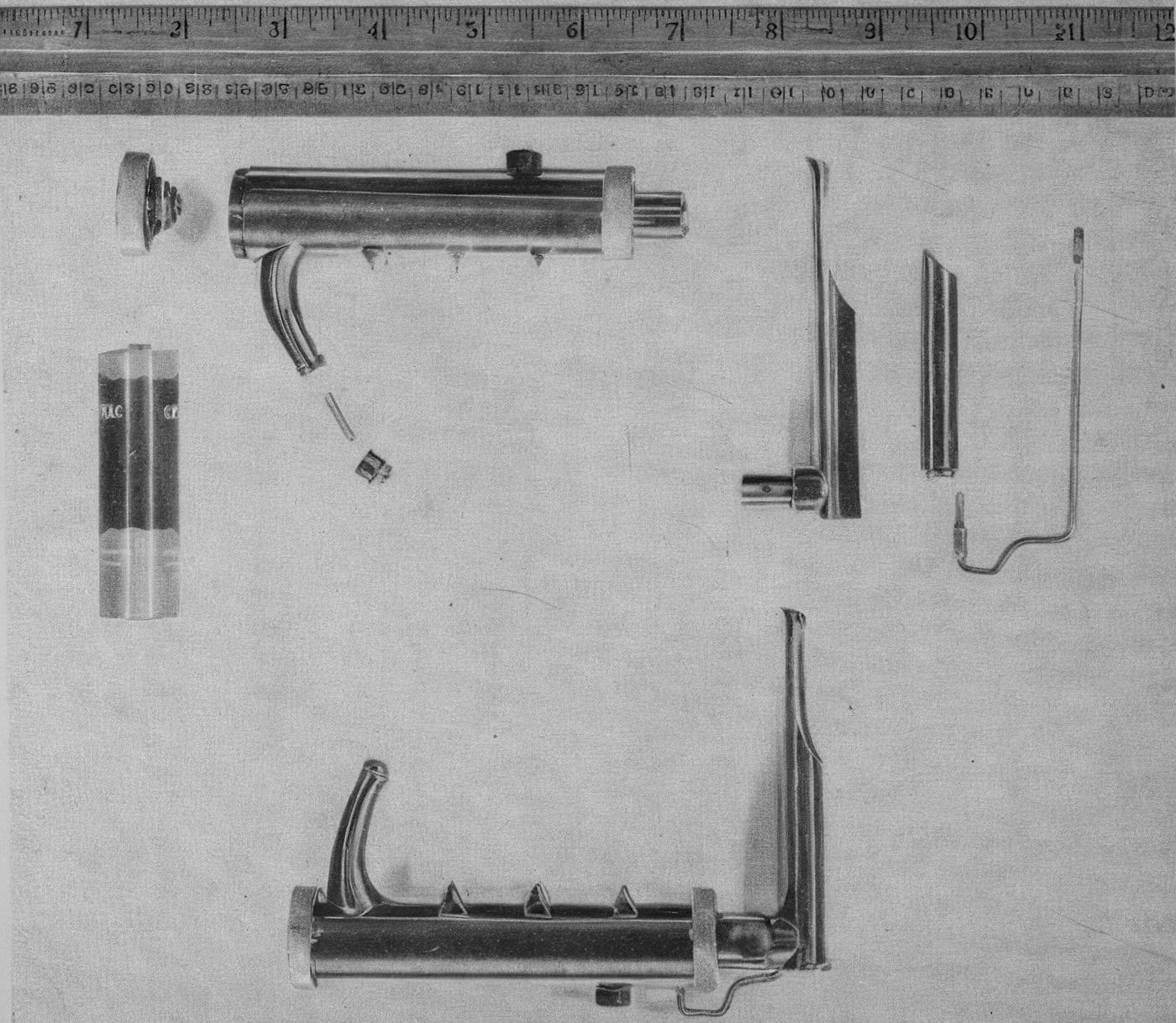
The Shadwell laryngoscope is a paediatric direct laryngoscope developed by Noel Alexander Gillespie in 1936 for endotracheal intubation in infants.
A modification of the smallest Chevalier Jackson laryngoscope, it was designed to overcome the limited working space and poor laryngeal view produced by contemporary adult laryngoscopes in the infant airway.
The name Shadwell derives from the Princess Elizabeth of York Hospital for Children in Shadwell, East London, where Gillespie practised paediatric and plastic-surgical anaesthesia.
Description
The Shadwell laryngoscope consisted of a small tubular straight blade with integrated illumination and a removable longitudinal slide. The design permits direct elevation of the infant epiglottis in the confined dimensions of the neonatal and infant upper airway.
During insertion, the slide completed the tubular blade and prevented the tongue and pharyngeal soft tissues from prolapsing into the field of view. Once the larynx and vocal cords had been exposed, the slide was removed, leaving sufficient space within the blade for passage of the endotracheal tube.
Historical development
1936 – Gillespie developed the Shadwell laryngoscope after finding contemporary adult instruments unsuitable for infant intubation. He adapted the smallest Chevalier Jackson laryngoscope to provide a smaller instrument with more working space for passage of the tracheal tube.
1939 – Gillespie published Endotracheal anesthesia in infants in the British Journal of Anaesthesia. He reported his experience with 197 paediatric intubations, including 76 children younger than 18 months, and described the laryngoscope developed for this purpose.
Magill’s laryngoscope, although excellent for use in adults, is not a convenient instrument for infants of less than eighteen months in age. Its shape makes it almost impossible to use, the blade is both too large and too thick, and the lamp-carrier, by projecting into the lumen of the speculum, both obstructs the view and impedes the passage of the tube. To overcome these difficulties, Messrs. Mayer and Phelps have kindly made for me a modification of the smallest size of Chevalier Jackson’s laryngoscope, which is retailed by A. Charles King Ltd. under the name of a “Shadwell” laryngoscope.
Gillespie, 1939
1941 – In Endotracheal Anaesthesia, Gillespie referred to two specialised infant laryngoscopes: the Shadwell laryngoscope and a smaller folding instrument developed at the University of Wisconsin. He described the Shadwell as an anaesthetist’s modification of the smallest Jackson laryngoscope.
1960s – Paediatric anaesthesia texts continued to describe the Shadwell blade but noted practical limitations. The handle was relatively heavy, the blade comparatively sharp, and optimum positioning required rotation of the instrument during use.
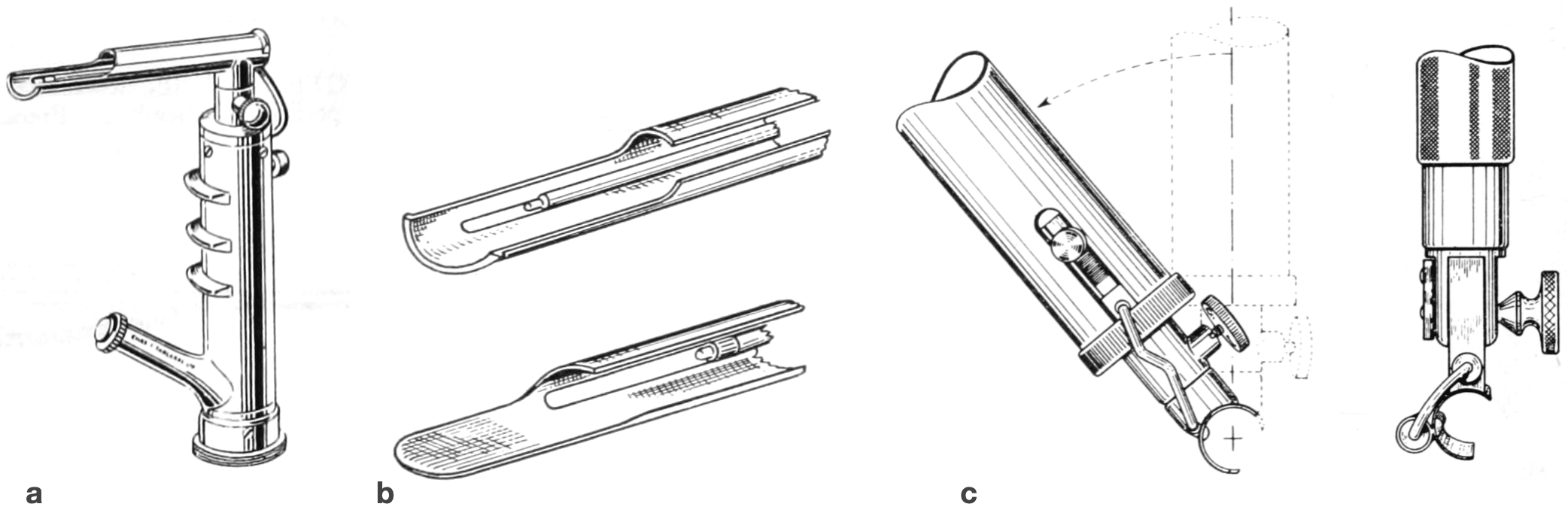
(a) Assembled Shadwell laryngoscope. (b) Blade comparison of the Shadwell blade (top) with the Magill blade (bottom), demonstrating the tubular construction and removable slide of the Shadwell design. (c) Diagram showing the characteristic 45-degree rotation required during insertion and use compared with Magill blade (right)
The instrument was progressively superseded by lighter and simpler paediatric straight blades, including the Miller, Oxford, Seward and later Robertshaw designs.
Eponymythology
The Shadwell laryngoscope is a toponym.
The instrument was designed by Noel Alexander Gillespie, but took its name from Shadwell in East London, the location of the Princess Elizabeth of York Hospital for Children.
Associated Persons
- Thomas Pomfret Kilner (1890–1964)
- Chevalier Jackson (1865–1958)
- Noel Alexander Gillespie (1904-1955)
Alternative names
- Shadwell laryngoscope
- Shadwell blade
- Shadwell infant laryngoscope
References
Historical references
- Gillespie NA. Endotracheal anesthesia in infants. Br J Anaesth 1939; 17(1): 2–12
- Gillespie NA. Endotracheal anaesthesia. 1941 [2e 1950]
Eponymous term review
- Chamberlain RN. Shadwell laryngoscope in treatment of asphyxia neonatorum. Nurs Mirror Midwives J. 1949 Apr 30;89(2299):75.
- Shadwell laryngoscope. Catalogue of surgical instruments and surgical sundries, 1960: 834
- Shadwell laryngoscope. General anaesthesia, 1965: 447-448
- Doherty JS, Froom SR, Gildersleve CD. Pediatric laryngoscopes and intubation aids old and new. Paediatr Anaesth. 2009 Jul;19 Suppl 1:30-7.
eponymictionary
the names behind the name

MBChB - Liverpool. RMO in Emergency Medicine at Sir Charles Gairdner Hospital, currently soaking up the sun down under. Aiming to pursue a career in anaesthetics.

BA MA (Oxon) MBChB (Edin) FACEM FFSEM. Emergency physician, Sir Charles Gairdner Hospital. Passion for rugby, medical history, medical education, and asynchronous learning #FOAMed evangelist. Editor-in-Chief and Webmaster of Life in the Fast lane, LITFL | On Call 4e| Eponyms | Books | Horology |