


Jørgen Reimers

Jørgen Reimers (1931-2008) was a Danish paediatric orthopaedic surgeon
Reimers was a paediatric orthopaedic surgeon whose work focused on neuromuscular hip instability, particularly in children with cerebral palsy. Working at Rigshospitalet in Copenhagen, Reimers developed a dynamic approach to the spastic hip based on muscle imbalance, progressive displacement and serial radiographic assessment.
In 1980 he formalised migration percentage (MP), a simple quantitative measure of lateral femoral-head displacement that became central to cerebral-palsy hip surveillance. He was also one of the founding surgeons of the European Paediatric Orthopaedic Society (EPOS) in 1982 and served as its fifth president from 1991 to 1992.
Biographical Timeline
- Born February 6, 1931 in Copenhagen, Denmark.
- 1969 – Working in the Outpatient Department for Handicapped Children at Rigshospitalet, Copenhagen, under paediatric neurologist Preben Plum.
- 1970 – Undertook an extended study visit to Sheffield with paediatric orthopaedic surgeon W. J. W. Sharrard, whose work on muscle imbalance and deforming forces strongly influenced Reimers’ approach to neuromuscular orthopaedics.
- 1971 – Studied in Toronto with Robert Bruce Salter (1924-2010), Norris Carroll, John Hall and Mercer Rang. Reimers credited this visit with reinforcing a dynamic concept of hip stability that was “not generally accepted at that time.”
- 1973 – Published Static and dynamic problems in spastic cerebral palsy, analysing the relationship between lower-limb muscle groups, sagittal balance and deformity in cerebral palsy.
- 1974 – Published a prospective study of 60 patients with cerebral palsy and hamstring contracture, comparing three operative methods. Reimers favoured proximal hamstring lengthening in selected patients over distal lengthening and the Egger procedure.
- 1975–1978 – Worked in the Department of Orthopaedic Surgery U, Rigshospitalet, under Professor C. C. Arnoldi. His major study of childhood hip stability was completed during this appointment.
- 1980 – Published his 100-page thesis The stability of the hip in children. A radiological study of the results of muscle surgery in cerebral palsy. Defined migration percentage (MP) as a quantitative measure of lateral migration of the femoral head relative to the acetabulum. Dr.med. at the University of Copenhagen
- 1982 March 13 – One of the 13 founding surgeons of the European Paediatric Orthopaedic Society (EPOS) at Hôpital Bretonneau, Paris.
- 1985 – Published on femoral-head containment following Legg–Calvé–Perthes disease.
- 1987 – Published on the treatment of acquired hip subluxation in cerebral palsy, continuing his work on neuromuscular hip instability.
- 1989 – Elected Vice-President of EPOS at the society’s eighth annual meeting in Helsinki.
- 1991 – Elected fifth President of EPOS, succeeding Henri Bensahel.
- 2000 – Retired from Children’s Orthopaedics at the National Hospital (Rigshospitalet), Copenhagen.
- Died on March 24, 2008 in Copenhagen, aged 77.
Medical Eponyms
Reimers migration percentage
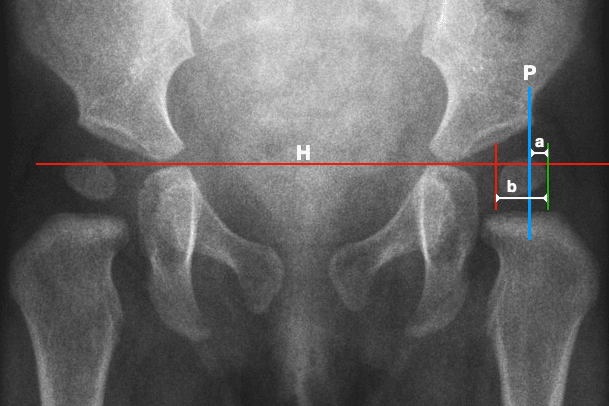
Reimers migration percentage (MP) is a radiographic measure of lateral femoral-head displacement relative to the acetabulum. It was developed for serial assessment of hip instability in children, particularly those with cerebral palsy.
On an AP pelvic radiograph, the horizontal width of the visible femoral head lying lateral to Perkins line is divided by the total visible femoral-head width and expressed as a percentage:
MP = lateral uncovered head width / total head width × 100
1980 – Reimers formalised the measurement in his thesis The stability of the hip in children. A radiological study of the results of muscle surgery in cerebral palsy. He used it to quantify progressive hip migration and to evaluate the effects of treatment.
Key Medical Contributions
Quantification of hip migration in cerebral palsy
Reimers introduced a reproducible method for following progressive lateral displacement of the femoral head over time. Migration percentage provided a common quantitative endpoint for surveillance, natural-history studies and assessment of treatment in the spastic hip.
Muscle imbalance and the spastic hip
Reimers believed that the developing hip is dynamically influenced by surrounding musculature, especially the balance between hip abductors and adductors. His research followed children longitudinally and used changes in MP to examine the effects of adductor release and other soft-tissue procedures.
He found that spontaneous outward migration was common in untreated cerebral-palsy hips and that adductor surgery could arrest or reverse migration in a proportion of cases. His studies suggested that age and the preoperative degree of migration influenced the response to treatment.
Radiographic methodology and positioning
Reimers examined potential sources of error in measuring femoral-head coverage. He investigated hip rotation and concluded that neutral rotation was clinically suitable for standard AP radiography.
Major Publications
- Reimers J. Static and dynamic problems in spastic cerebral palsy. J Bone Joint Surg Br. 1973 Nov;55(4):822-7.
- Reimers J. Contracture of the hamstrings in spastic cerebral palsy. A study of three methods of operative correction. J Bone Joint Surg Br. 1974 Feb;56(1):102-9.
- Reimers J. Stabiliteten af børns hofteled bedømt ved ét røntgenfoto [Stability of the hip-joint in children assessed by X-ray photograph]. Ugeskr Laeger. 1979 Jan 22;141(4):231-3.
- Reimers J. The stability of the hip in children. A radiological study of the results of muscle surgery in cerebral palsy. Acta Orthop Scand Suppl. 1980;184:1-100.
- Reimers J, Bialik V. Influence of femoral rotation on the radiological coverage of the femoral head in children. Pediatr Radiol. 1981;10(4):215-8.
- Reimers J. Incidence of full containment of the femoral head after Legg-Calvé-Perthes disease and in the “normal” hip. J Pediatr Orthop. 1985 Mar-Apr;5(2):199-201.
- Reimers J. Treatment of acquired hip subluxation in cerebral palsy. J Pediatr Orthop. 1987 Sep-Oct;7(5):605-6.
- Reimers J, Pedersen B, Brodersen A. Foot deformity and the length of the triceps surae in Danish children between 3 and 17 years old. J Pediatr Orthop B. 1995;4(1):71-3.
References
Biography
- Jørgen REIMERS. EPOS
Eponymous terms
- Faraj S, Atherton WG, Stott NS. Inter- and intra-measurer error in the measurement of Reimers’ hip migration percentage. J Bone Joint Surg Br. 2004 Apr;86(3):434-7.
- Analan PD, Yilmaz EE, Adam M, Leblebici B. The effect of physician experience on the measurement reliability of the Reimers’ hip migration percentage in children with cerebral palsy. J Phys Ther Sci. 2015 Oct;27(10):3255-8.
- Amen J, Perkins O, Cadwgan J, Cooke SJ, Kafchitsas K, Kokkinakis M. Measuring hip migration percentage in cerebral palsy using the HipScreen app. Bone Jt Open. 2023 May 22;4(5):363-369
Eponym
the person behind the name

MB BAO BCh Trinity College Dublin, MSc Clinical Data Analytics University of Galway. Junior doctor in Perth, doctoral researcher in MRI radiomics. Working towards radiology training.

BA MA (Oxon) MBChB (Edin) FACEM FFSEM. Emergency physician, Sir Charles Gairdner Hospital. Passion for rugby, medical history, medical education, and asynchronous learning #FOAMed evangelist. Editor-in-Chief and Webmaster of Life in the Fast lane, LITFL | On Call 4e| Eponyms | Books | Horology |