


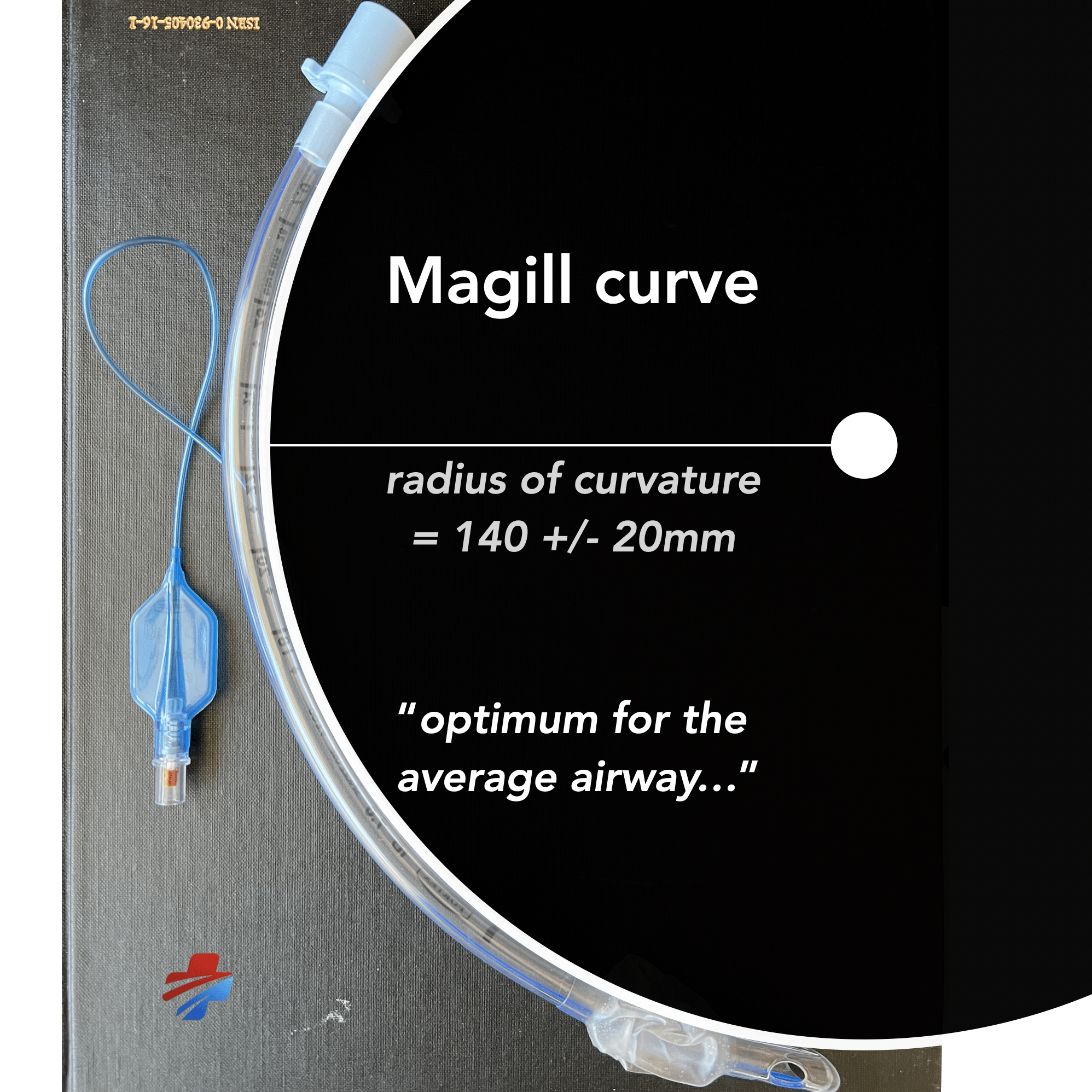
The Magill curve is the characteristic curvature of a Magill-type endotracheal tube, derived from the observation of Ivan Magill, that a naturally curved rubber tube could follow the anatomical path from the nose towards the glottis during nasotracheal intubation.
Modern adult tracheal tubes have a nominal radius of curvature of approximately 140 ± 20 mm.
Modern significance
The Magill curve remains incorporated into the geometry of conventional preformed endotracheal tubes used for oral and nasal tracheal intubation.
The current ISO standard for tracheal tubes defines a Magill-type tracheal tube of size 6.5 mm or greater as having a radius of curvature of 140 ± 20 mm.
The curvature provides a compromise between the geometry required to negotiate the upper airway and the need for the tube to remain sufficiently straight once positioned within the trachea.
Development of the Magill curve
1920s – At Sidcup, Ivan Magill and Stanley Rowbotham progressively moved from narrow intratracheal insufflation catheters towards wider tracheal tubes through which the patient could breathe in and out.
Magill later recalled experimenting with rubber tubing of different diameters, stiffness and curvature before suitable purpose-made tubes became commercially available. His first useful wide-bore tube was cut from tubing taken from an old Boyle anaesthetic machine. He later obtained commercially available rubber tubing and experimented with its physical characteristics.
The natural curvature retained by tubing stored in coils proved particularly useful for nasal intubation.
1928 – In Endotracheal Anæsthesia, Magill described the anatomical basis of blind nasal intubation. With the head in slight extension, he found that the airway from the nostril to the glottis formed a gentle curve. A rubber tube with a corresponding curve could therefore naturally follow this path and enter the glottis.
In the normal subject…in a position of slight extension, the course of the air-way from the nostril to the glottis is a gentle curve, and a rubber tube with a similar curve, or a catheter mounted on a curved stilette, can naturally be made to follow that course and enter the glottis. In fact, with the head in the correct position in relation to the body, the tube will enter the glottis more readily than the oesophagus.
Magill 1928
1930 – In Technique in endotracheal anaesthesia, Magill recommended commercial rubber tubing because it was inexpensive, resilient and sufficiently firm to maintain its lumen.
Magill had observed that manufacture and storage in coils produced a natural curvature. He considered this curve essential for allowing the tube to follow the route from the nose to the larynx and noted that the retained curvature avoided the need for a wire stylet.
Magill recommended several graduated tube sizes and advised using the largest tube that the larynx could comfortably accommodate.
Modern standardisation
1984 – The geometry associated with Magill became incorporated into formal standards for tracheal tubes. ISO 5361-2 specified oro-tracheal and naso-tracheal tubes of the Magill type.
2002 – Chandler published Tracheal intubation and sore throat: a mechanical explanation. They investigated the mechanical interaction between tracheal tubes and the upper airway using an experimental model. The study found that tube size, stiffness and curvature influenced contact with the pharyngeal wall. The paper concluded that the standard Magill curve, with a radius of approximately 140 ± 20 mm, was “about optimum” for the average airway.
2023 – Current ISO 5361 retains the term and specifies a radius of curvature of 140 ± 20 mm for Magill-type adult tubes of size 6.5 mm and greater.
Eponymythology
Magill did not use the term “Magill curve” in his original publications.
In 1928 he described the airway itself as following a gentle curve and recognised that a similarly curved rubber tube would naturally follow this path. In 1930 he described the retained curvature of coiled commercial rubber tubing and its value during nasal intubation.
The term Magill curve was applied later to this tube geometry.
Associated Persons
- Edgar Stanley Rowbotham (1890-1979)
- Sir Ivan Whiteside Magill (1888-1986)
References
Historical references
- Magill I. Endotracheal Anæsthesia. Proc R Soc Med. 1928; 22(2): 83–88.
Eponymous term review
- Chandler M. Tracheal intubation and sore throat: a mechanical explanation. Anaesthesia. 2002 Feb;57(2):155-61.
- ISO 5361. Anaesthetic and respiratory equipment — Tracheal tubes and connectors. Current standard specifies the geometry of Magill-type tracheal tubes.
eponymictionary
the names behind the name

BSc MD, University of Western Australia (UWA). Medical interests in critical care, FOAMed and simulation training. Outside of medicine, I'm passionate about sport, camping and the outdoors.

BA MA (Oxon) MBChB (Edin) FACEM FFSEM. Emergency physician, Sir Charles Gairdner Hospital. Passion for rugby, medical history, medical education, and asynchronous learning #FOAMed evangelist. Editor-in-Chief and Webmaster of Life in the Fast lane, LITFL | On Call 4e| Eponyms | Books | Horology |