


Louis Ombrédanne
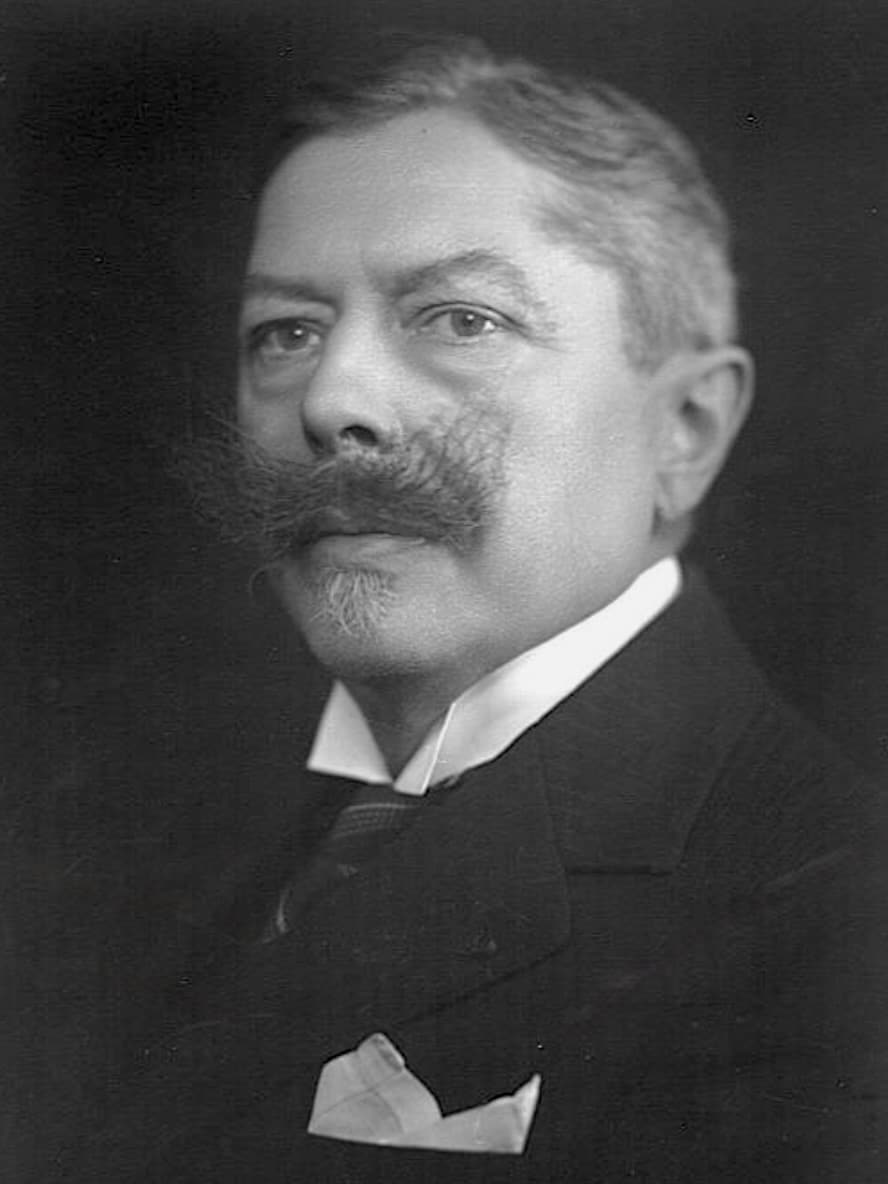
Louis Marie Arsène Ombrédanne (1871-1956) was a French paediatric surgeon
Ombrédanne worked across congenital deformity, urology, orthopaedics, anaesthesia and reconstructive surgery. His contributions included early immediate breast reconstruction, operative techniques for cryptorchidism and hypospadias, a portable ether inhaler, and radiographic methods for assessing congenital hip dislocation.
His name is associated with the Ombrédanne inhaler, Ombrédanne operation for transscrotal orchidopexy, Ombrédanne pouch operation for hypospadias, Ombrédanne–Armingeat syndrome, Ombrédanne quadrants and Ombrédanne line in radiographic assessment of the paediatric hip.
Biographical Timeline
- Born on March 5, 1871 in the Faubourg Saint-Antoine, Paris, the son of a general practitioner.
- 1893 – Appointed externe des hôpitaux de Paris after studying at the Lycée Michelet and entering the Faculty of Medicine in Paris.
- 1895-1899 – Appointed interne des hôpitaux. Surgical training with Alfred Blum (Saint-Antoine), Simon Duplay (Hôtel-Dieu), Charles Nélaton (Hôpital Saint-Louis) and Odilon Lannelongue (Hôpital des Enfants-Malades). Worked in anatomy, becoming aide d’anatomie and subsequently prosector.
- 1900 – Completed his medical thesis, Les Lames Vasculaires dans l’Abdomen, le Bassin et le Périnée. Birth of son Marcel Ombrédanne (1900–1978) who became an ENT surgeon, involved in the early French plastic-surgery community
- 1902 – Appointed chirurgien des hôpitaux de Paris. Assistant to Nélaton at Saint-Louis and Boucicaut while awaiting his own service.
- 1906 – Described immediate breast reconstruction following mastectomy using a pectoralis minor muscle flap combined with an axillothoracic flap.
- 1907 – Became agrégé de chirurgie and developed portable ether inhalation apparatus
- 1908 – Took charge of the children’s surgical service at Hôpital Saint-Louis
- 1910 – Transferred to Hôpital Bretonneau, where he continued paediatric surgery and teaching.
- 1912 – Published Technique chirurgicale infantile, his operative approach to paediatric surgery.
- 1914 – Mobilised during the First World War. Encountered gas gangrene and extensive traumatic injury in Verdun.
- 1915 – Transferred to the maxillofacial surgical centre at Tours, applying reconstructive techniques to severe facial war injuries.
- 1917 – With Ledoux-Lebard published Localisation et extraction des projectiles
- 1918–1921 – Returned to Paris after the Armistice, directing children’s surgical services while continuing reconstruction of military facial injuries at Val-de-Grâce.
- 1923 – Published the first edition of Précis clinique et opératoire de chirurgie infantile, including his horizontal–vertical line and radiographic localisation method for congenital hip dislocation.
- 1924 – Succeeded Auguste Broca as professor of Clinical Paediatric Surgery and Orthopaedics at the Hôpital des Enfants-Malades.
- 1929 October 10 – Founding member of SICOT (Société Internationale de Chirurgie Orthopédique et de Traumatologie), at the founding meeting at the Hôtel de Crillon, Paris.
- 1938 – Commerorative medal issued celebrating 30 years of paediatric surgical and orthopaedic practice and teaching
- 1941 – Retired as chair of paediatric surgery
- 1952 – In retirement, co-authored an introductory book on bookbinding (Initiation à la reliure à l’usage des amateurs et des débutants)
- Died on November 4, 1956, aged 85
Medical Eponyms
Ombrédanne ether inhaler (1908)
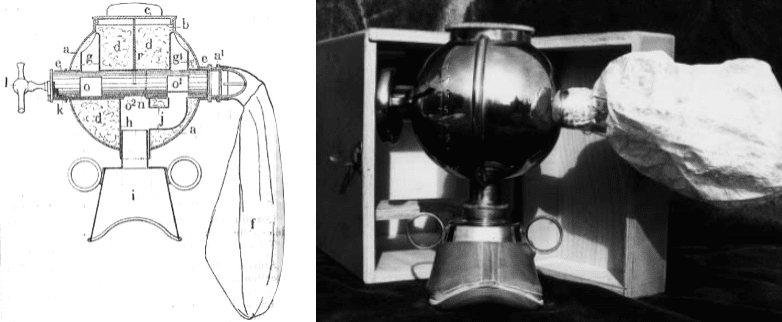
1908 – Ombrédanne was critical of contemporary inhalers for interrupted administration, limited ether evaporation and unstable anaesthetic depth. In 1908 he introduced his appareil pour l’anesthésie par l’éther. This apparatus incorporated a chamber containing an ether-soaked sponge and a graduated control lever that varied the mixture of fresh air and ether-enriched rebreathed gas.
The Ombrédanne inhaler became one of the most widely used ether anaesthesia devices in France and subsequently spread through Europe, South America, the Soviet Union and Japan. The manufacturer Collin reportedly sold more than 25,000 units, and the apparatus remained in civilian and military until the 1950s.
Ombrédanne–Armingeat syndrome (1922)
Ombrédanne–Armingeat syndrome (syndrome pâleur-hyperthermie) was a historical postoperative syndrome of infants characterised by progressive hyperthermia, striking pallor, tachycardia and rapid clinical deterioration, sometimes resulting in sudden death.
Ombrédanne provided an early publication on the syndrome in 1922 and discussed it in the first edition of his Précis clinique et opératoire de chirurgie infantile in 1923. His pupil Jean Armingeat (1897–1945) investigated the condition under Ombrédanne’s supervision, resulting in his 1929 doctoral thesis and their joint report that year.
Some later authors have associated the syndrome with malignant hyperthermia. However, Ombrédanne documented episodes after local anaesthesia and even without anaesthesia, and argued that the particular anaesthetic agent was not the principal cause. The syndrome is better described as a historical antecedent of perioperative hyperthermic syndromes rather than an earlier synonym for modern malignant hyperthermia.
Ombrédanne operation (1910) [transscrotal orchidopexy]
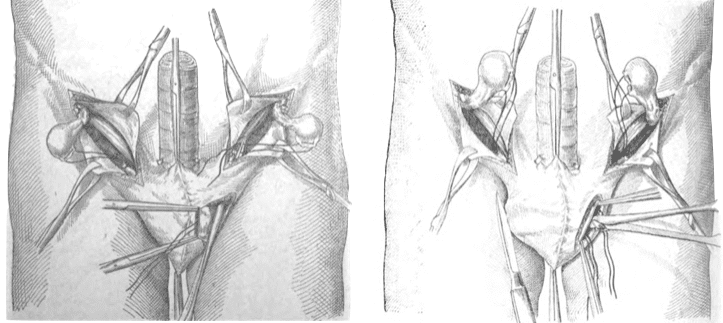
1910 – Ombrédanne published Indications et technique de l’orchidopexie transscrotale chez l’enfant describing transscrotal orchidopexy for palpable undescended testes in children. After inguinal mobilisation, the testis was passed through a tunnel across the scrotal septum and brought out through the opposite hemiscrotum before being placed in a subcutaneous pouch. He advocated early surgery to reduce the risk of progressive testicular degeneration and reported 21 unilateral and four bilateral procedures.
Ombrédanne pouch operation for hypospadias (1911)
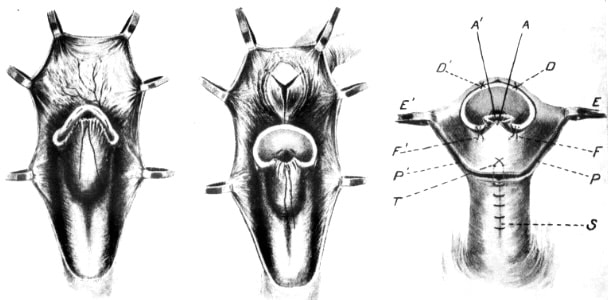
1911 – Ombrédanne published Hypospadias pénien chez l’enfant. He described a staged double-flap repair for penile hypospadias in children, adapted from the bladder exstrophy operation of Paul Segond. A proximal skin flap was folded forward to create a small urethral “pouch” (petit sac), with a perforated preputial flap providing external cover.
1933 – Henry H. M. Lyle published “Ombrédanne’s pouch operation for hypospadias”, as the first English language presentation of the now eponymous operation. Lyle illustrated the technique in detail and regarded it as a useful method for selected cases of hypospadias, while also discussing modifications and technical limitations.
Ombrédanne quadrants and Ombrédanne line
1923 – In the first edition of Précis clinique et opératoire de chirurgie infantile, Ombrédanne described a radiographic method for localising the femoral-head ossific nucleus in congenital hip dislocation. He constructed a horizontal reference through the acetabular-floor shadows and a vertical tangent to the lateral acetabular roof. In the normal hip the ossific nucleus lay below the horizontal and medial to the vertical; with increasing displacement it moved first laterally and then superolaterally.
Ombrédanne’s vertical construction predated the descriptions of Heinrich Hilgenreiner (1925) and George Perkins (1928). The vertical component is geometrically equivalent to the acetabular reference subsequently now known as the Perkins line. Note: the accompanying horizontal reference in Ombrédanne’s original construction was not Hilgenreiner line.
In the normal hip the ossific nucleus lay below the horizontal and medial to the vertical. With progressive dislocation it moved laterally and then superiorly.
- A = normal position of the femoral-head ossific nucleus. Below the horizontal, and medial to the vertical
- B = early displacement. The nucleus remains just below the horizontal but, lateral to the vertical
- C = advanced dislocation. The nucleus lies above the horizontal and lateral to the vertical
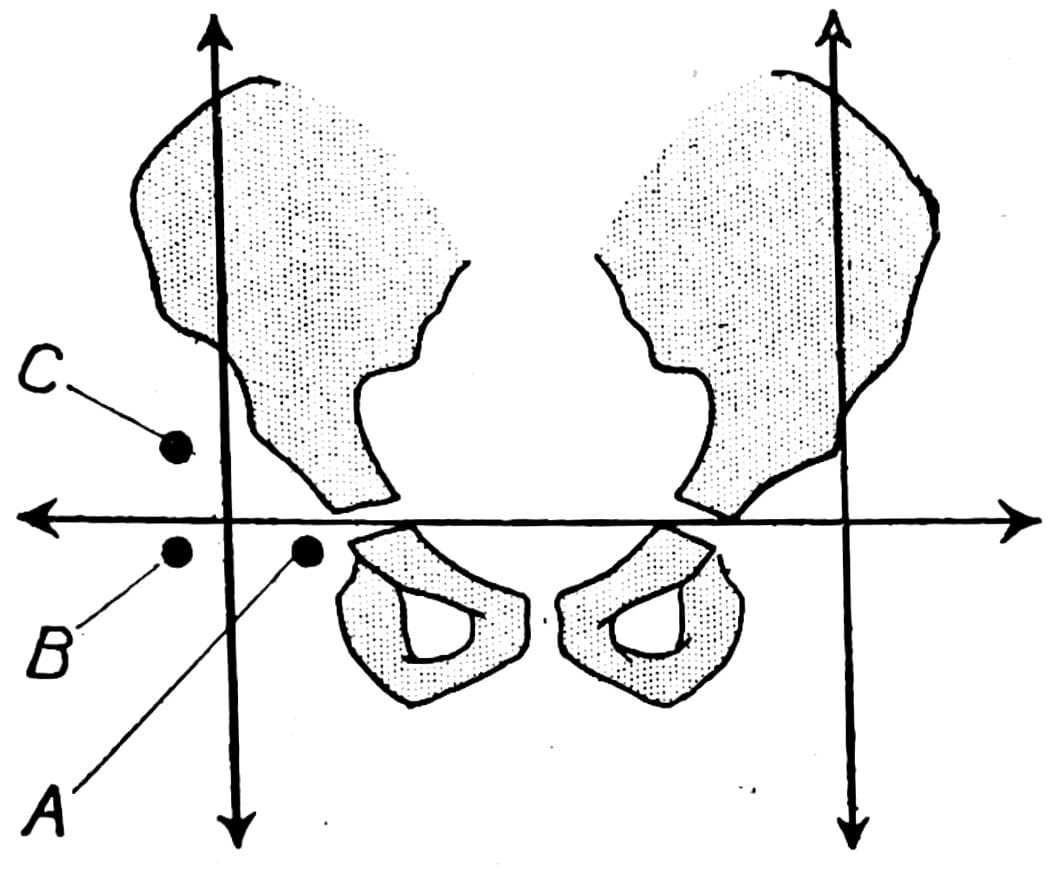
1932 – Ombrédanne retained the method in the third edition of his textbook, again illustrating the normal and progressively displaced positions of the femoral-head ossific nucleus.
Major Publications
- Ombrédanne L. Les Lames Vasculaires dans l’Abdomen, le Bassin et le Périnée. 1900
- Nélaton C, Ombrédanne L. La Rhinoplastie. 1904
- Ombrédanne L. Titres et travaux scientifiques. 1904, 1907, 1924
- Ombrédanne L. Reconstruction autoplastique, du sein après amputation totale. Bull Mem Soc Chir Paris, 1906; 32: 490-493.
- Nélaton C, Ombrédanne L. Les Autoplasties. 1907
- Ombrédanne L. Muscles, aponévroses, tendons, tissus péritendineux, bourses séreuses. 1907
- Ombrédanne L. Un appareil pour l’anesthésie par l’éther. Gazette des hôpitaux civils et militaires 1908; 81(92): 1095-1100
- Ombrédanne L. Précis de pathologie externe; poitrine et abdomen. 1909
- Ombrédanne L. Indications et technique de l’orchidopexie transscrotale chez l’enfant. Presse médicale, 1910; 18(81): 745-750 [Ombrédanne operation]
- Ombrédanne L. Communication: Hypospadias pénien chez l’enfant. Bulletins et mémoires de la Société de Chirurgie, Paris, 1911; 37: 1076 [Ombrédanne pouch operation]
- Ombrédanne L, Ledoux-Lebard R. Localisation and extraction of projectiles. 1918
- Jeanbrau E, Nové-Josserand P, Ombrédanne L, Desiosses P. Chirurgie réparatrice et orthopédique. 1920 [Tome II]
- Ombrédanne L. Précis clinique et opératoire de chirurgie infantile. 1923 [3e 1932]
- Ombrédanne L, Armingat J. Le syndrôme paleur et hyperthermie chez les nourissons opérés. Gazette des hôpitaux, 1929; 88(102): 1561–1574 [Ombrédanne–Armingeat syndrome]
- Ombrédanne L. De l’influence de l’anesthésique employé dans la genèse des accidents post-opératoires de pâleur-hyperthermie observés chez les nourrissons. Revue Médicale Française. 1929;10:617–618. [Ombrédanne–Armingeat syndrome]
- Ombrédanne L. Quelques vérités premières (ou soi-disant telles) en chirurgie infantile. 1936
- Ombrédanne L. Les hermaphrodites et la chirurgie. 1939
References
Biography
- Barrère A. A Cluster of Surgeons. 1910
- Biographie du Docteur Louis Ombrédanne. L’Album du Rictus, journal humoristique mensuel 1910/1911 Tome IV
- Le Professeur Ombrédanne. Chanteclair. 1931: 95
- Louis Ombredanne, 1871-1956. Rev Chir Orthop Reparatrice Appar Mot. 1956 Dec;42(6):I-IV.
- Sauvé JM. Le professeur Louis Ombrédanne; 1871-1956. Bull Acad Natl Med. 1956 Dec 11-18;140(34-35):673-6.
- Mialaret J. Louis Ombrédanne (1871-1956). Mem Acad Chir (Paris). 1969;95(1):101-15.
- Glicenstein J. Louis Ombrédanne (1871-1956), chirurgien pédiatre et plasticien. Ann Chir Plast Esthet. 2015 Apr;60(2):87-93.
- Caton JH, Konaté S, Journeau P, Scarlat MM. Louis Ombrédanne, a founding member of SICOT. Int Orthop. 2021 Aug;45(8):2159-2163.
- Fresquet Febrer JL. Louis Ombrédanne (1871-1956) Historia de la Medicina 2020
Eponymous terms
- Lyle HHM. Ombrédanne’s pouch operation for hypospadia. Annals of Surgery 1933; 98: 513–519
- Teimourian B, Adham MN. Louis Ombredanne and the origin of muscle flap use for immediate breast mound reconstruction. Plast Reconstr Surg. 1983 Dec;72(6):905-10.
- Androutsos G. Louis Ombrédanne (1871-1956) et la cure de l’hypospadias. Prog Urol. 2003 Apr;13(2):277-84.
- Plötz J. Der Atherinhalator nach Louis Ombrédanne. Anmerkungen zu seiner Karriere ausserhalb Frankreichs und zu seinem Erfinder. Anaesthesist. 2001 Aug;50(8):605-11.
- Ombrédanne Inhaler. Wood Library Museum of Anesthesiology [Video]
- Kyle E, Cadogan M. Hip and pelvic lines and arcs. LITFL
Eponym
the person behind the name

BA MA (Oxon) MBChB (Edin) FACEM FFSEM. Emergency physician, Sir Charles Gairdner Hospital. Passion for rugby, medical history, medical education, and asynchronous learning #FOAMed evangelist. Editor-in-Chief and Webmaster of Life in the Fast lane, LITFL | On Call 4e| Eponyms | Books | Horology |