

Dressler beat
Dressler beat: Specifically a 'ventricular fusion beat' in the presence of paroxysmal ventricular tachycardia. Wide complex tachycardia with VT

Dressler beat: Specifically a 'ventricular fusion beat' in the presence of paroxysmal ventricular tachycardia. Wide complex tachycardia with VT
Ludwig angina: rapidly progressive gangrenous bilateral cellulitis of the submandibular space with risk of life-threatening airway compromise. 1836 - Wilhem Frederick von Ludwig was the first to clearly describe this disorder and differentiate it from other types of 'inflammation' in the neck.
Max Hamilton (1912-1988) was a German born British Psychiatrist and statistician
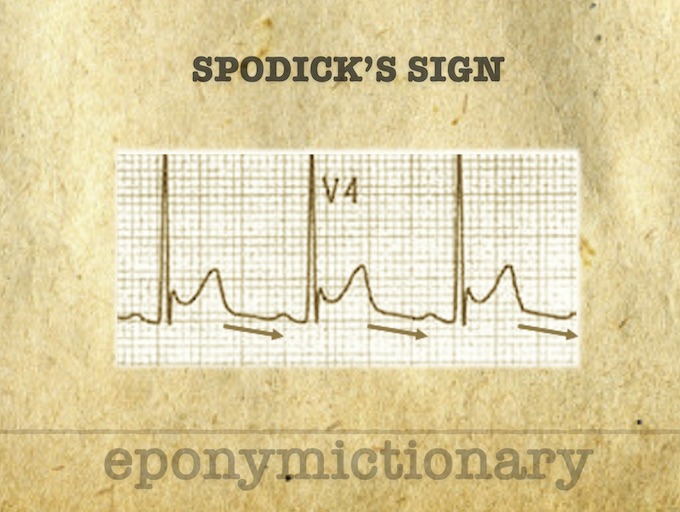
Spodick Sign: Stage I Pericarditis, a downsloping of the TP line. Described 1974 by American Cardiologist, David H Spodick (1927 – 2019)

David H Spodick (1927 – 2019) was an American Cardiologist. Eponymously affiliated with Spodick's sign in acute pericarditis (1974)
Biography Born Lissa, 1825 studied medicine at Breslau, Heidelberg and Berlin 1857 – Breslau as an ophthalmologist 1894 – life member of the Prussian House of Lords Died 1902 Medical Eponyms Key Medical Contributions Major Publications Controversies References Biography Grzybowski A,…
Description Fuchs Spots is a term used to describe a raised, circular, pigmented lesion at the macular which develops after a subretinal haemorrhage has been absorbed. It is associated with moderate to high myopia. History of Fuchs Spots 1862 –…
Description Fuchs uveitis syndrome is a chronic non-granulomatous condition of uncertain cause. There is usually unilateral heretochromia iridis, white eye with stellate and grey-white keratic precipitates. There are no posterior synechiae. On Gonioscopy may see fine radial angle vessels which are…
Description Fuchs endothelial corneal dystrophy is characterised by bilateral endothelial cell loss. Examination signs include: central guttata – the presence of irregular warts or excrescences on Descemet membrane secreted by abnormal endothelial cells tiny dark spots caused by distribution of…

Francis John Murphy (1900 - 1972) was an American anesthesiologist. Murphy Endotracheal Tube and the Murphy eye (1941)

Right Bundle Branch Block (RBBB) activation of the right ventricle is delayed as depolarisation spreads across septum from left ventricle.

A nurse practitioner’s personal and debilitating experience of long COVID - Mastering Intensive Care 063 with Naomi Pratt