


Heinrich Hilgenreiner

Heinrich Hilgenreiner (1870–1953) was a German-Bohemian surgeon and orthopaedist
Hilgenreiner pioneered the early radiographic diagnosis and conservative treatment of congenital hip dislocation in infants. His work concentrated on the management of developmental hip dysplasia with earlier recognition, objective radiographic assessment and gentler treatment in infancy.
In 1925 he described a radiographic measurement system based including a horizontal through the triradiate cartilages (Hilgenreiner line), vertical line (Perkins line) and the acetabular index (Tönnis angle). He also developed an abduction splint designed to maintain reduction while avoiding cumbersome plaster immobilisation.
Biographical Timeline
- Born on November 3, 1870 in Haid, West Bohemia (now Bor, Czech Republic), son of architect Ludwig Hilgenreiner and his wife Marie.
- Childhood – Grew up in Haid, attended the local Volksschule, then the German gymnasium at Mies. His elder brother Karl Hilgenreiner (1867–1948) later became a theologian, university professor and politician.
- 1896 – Graduated in medicine / received his doctorate from the German Charles-Ferdinand University in Prague.
- 1897–1903 – Surgical postgraduate training (chirurgische Weiterbildung) in Prague under Anton Wölfler (1850–1917).
- 1904 – Worked in paediatric orthopaedic surgery at the Second Children’s Clinic in Prague
- 1905 – With Viktor Lieblein (1869–1935) published Die Geschwüre und die erworbenen Fisteln des Magen-Darmkanals
- 1907 – Habilitated in surgery at the German University in Prague and became a university lecturer (Privatdozent).
- 1914–1918 – Served as a military doctor (Truppenarzt) during the First World War.
- 1925 – Published his influential work on congenital dislocation of the hip describing the horizontal line through the triradiate cartilages now known as Hilgenreiner line.
- 1920s – Developed the Hilgenreiner abduction splint, advocating gentler early abduction treatment for congenital hip dislocation in place of more forceful reduction methods.
- 1930 – Awarded the title of extraordinary professor (außerordentlicher Professor) at the German University in Prague. Consultant to the German University Clinic at the Landesfindelanstalt Prag
- 1934–1935 – Published his accumulated experience with early treatment and the abduction splint, including 10 Jahre Abduktionsschiene und Frühbehandlung der angeborenen Hüftverrenkung and the major review Die angeborene Dysplasie der Hüfte.
- 1945–1946 – Following the end of the Second World War, Hilgenreiner was interned for 13 months at Pankrác prison in Prague.
- 1946 – Expelled from Czechoslovakia to Austria during the wider post-war removal of the German population and not following conviction for wartime collaboration
- Died on October 24, 1953 in Spillern, Lower Austria, aged 82; buried at Friedhof Spillern.
Medical Eponyms
Hilgenreiner line (1925)
Hilgenreiner line is a horizontal radiographic reference line drawn through the triradiate cartilages of the paediatric pelvis. It is used in the assessment of developmental dysplasia of the hip, particularly as the baseline for measurement of the acetabular index and in conjunction with the perpendicular Perkins line.
1925 – Hilgenreiner introduced the line in Zur Frühdiagnose und Frühbehandlung der angeborenen Hüftgelenkverrenkung, as a method of assessing the infant hip before ossification of the femoral head. The horizontal Hilgenreiner line is commonly used together with Perkin line, a vertical reference drawn perpendicular to it at the lateral acetabular margin.
My procedure is to draw a horizontal line connecting the two Y-shaped cartilages.
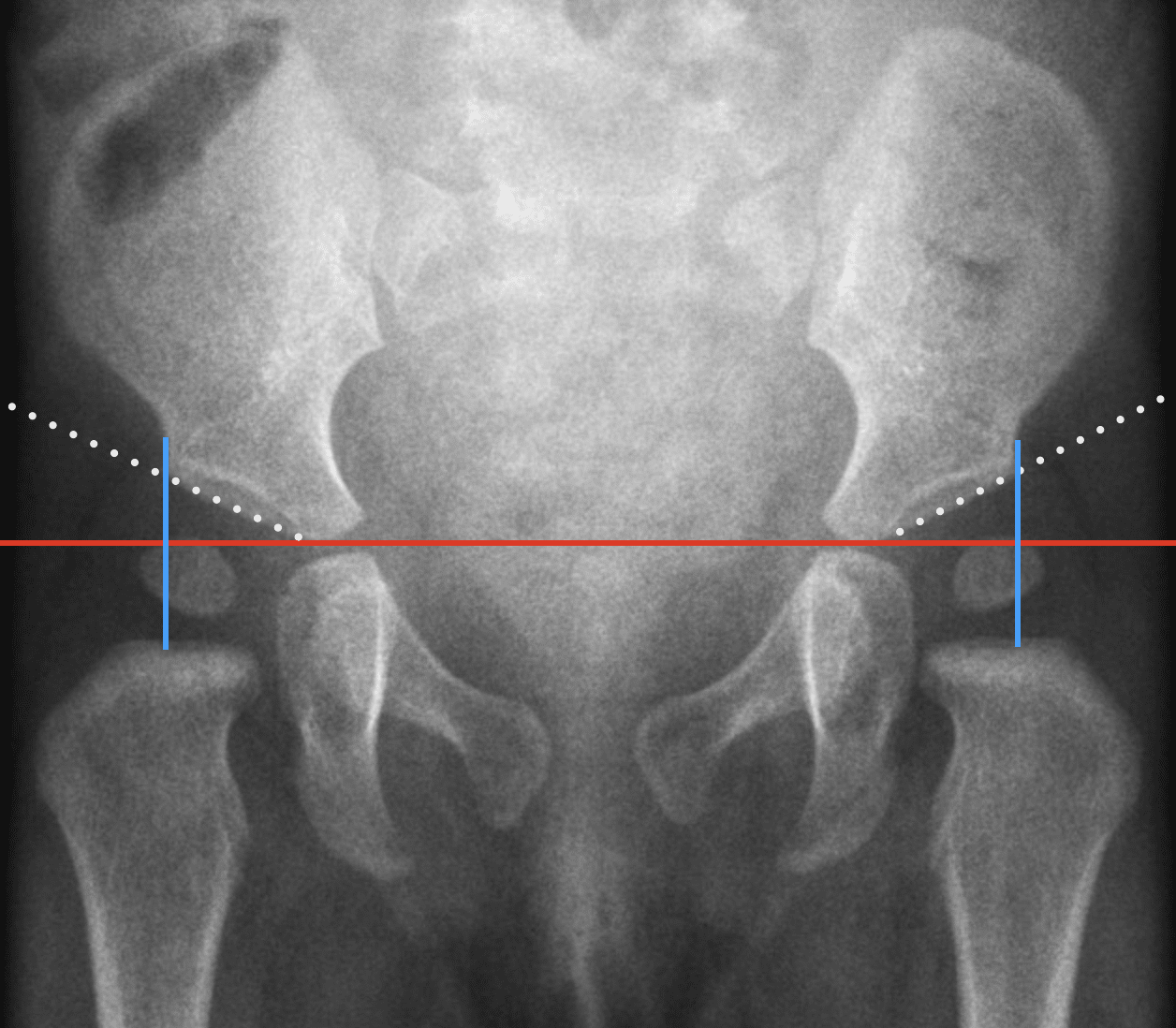
His aim was to improve radiographic assessment before ossification of the femoral head, as older methods relying on the visible epiphysis were unreliable. He drew a line connecting the two triradiate cartilages, then measured the vertical and horizontal relationship of the proximal femur to this baseline and the inclination of the acetabular roof. The horizontal baseline was combined with measurements of femoral height (h), lateral displacement (d) and acetabular roof inclination (α).
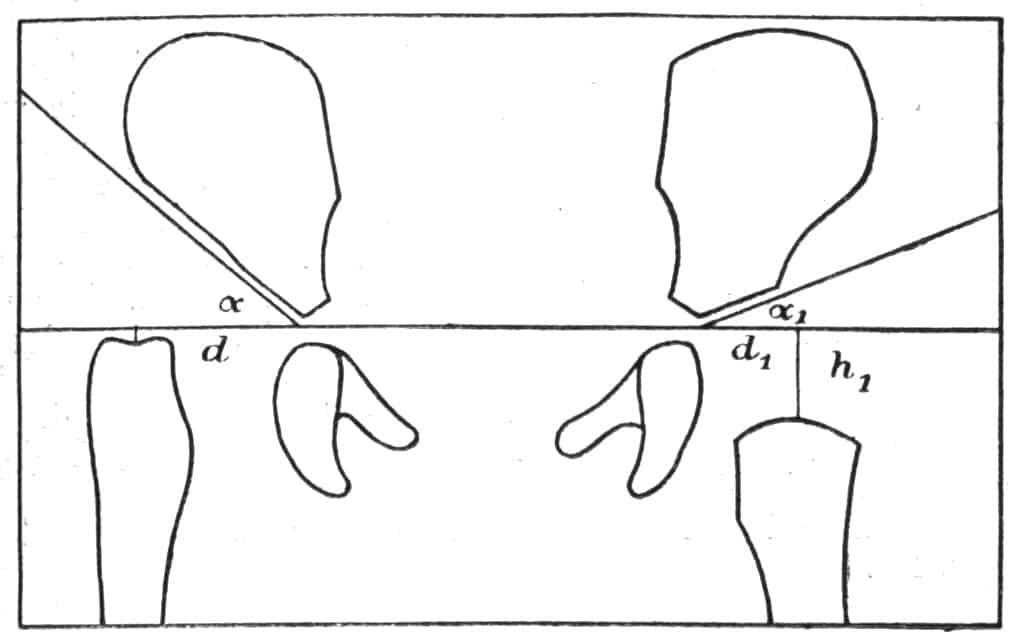
Hilgenreiner’s horizontal pelvic baseline subsequently became the reference for the acetabular index, which Dietrich Tönnis later standardised with age-related normal and pathological ranges and which is now commonly termed the Tönnis angle.
Hilgenreiner brace / splint
Hilgenreiner brace (Hilgenreiner-Schiene; Hilgenreiner abduction splint) is an abduction-retention device used following reduction of congenital hip dislocation in infants.
Hilgenreiner described the splint in 1925 as part of his programme of earlier, gentler treatment in infancy. It maintained the thighs in marked abduction while avoiding the hygiene and practical problems of circumferential plaster fixation and allowed treatment to be continued on an outpatient basis. He usually applied the splint bilaterally, including in unilateral disease, to improve retention and limit rotation.
For retention of the reduced femoral head in the infant … one is best served by the described or a similar abduction splint, which, among other advantages, permits treatment to be carried out on an outpatient basis.
Modified forms of the Hilgenreiner brace remain in use in Central European paediatric orthopaedic practice. A 2022 series describes fixation at approximately 90° flexion and 80° abduction.
Major Publications
- Lieblein V, Hilgenreiner H. Die Geschwüre und die erworbenen Fisteln des Magen-Darmkanals, 1905
- Hilgenreiner H. Zur Frühdiagnose und Frühbehandlung der angeborenen Hüftgelenkverrenkung. Medizinische Klinik 1925; 21: 1385-1388, 1425-1429
- Hilgenreiner H. Beitrag zur Atiologie der Osteochondritis coxae juvenilis. Medizinische Klinik. 1933; 29: 494
- Hilgenreiner H. 10 Jahre Abduktionsschiene und Frühbehandlung der angeborenen Hüftverrenkung. Zeitschrift für Orthopädische Chirurgie einschliesslich der Heilgymnastik und Massage, 1935; 63: 344-383.
- Hilgenreiner H. Zur angeborenen Dysplasie der Hüfte. Zeitschrift für Orthopädie und ihre Grenzgebiete 1939; 69: 30–51
- Hilgenreiner H. Weiterer Reitrag zur Lehre und Rehandlung der angeborenen Hüftverrenkung. Fort mit dem Gipsverband! Zeitschrift für Orthopädie und ihre Grenzgebiete 1939; 70: 212-234
- Hilgenreiner H. Zur Schienenbehandlung der angeborenen Hüftverrenkung beim älteren Kind. Zeitschrift für Orthopädie und ihre Grenzgebiete 1947; 76: 4–29
Historical notes and controversies
Date of death
The date of Hilgenreiner’s death is inconsistently reported in modern secondary sources. For example Bi et al. (2023) and Radiopaedia give October 24, 1954. However, most German-language biographical sources give October 24, 1953 in Spillern, Lower Austria.
Primary evidence such as the municipal cemetery record for Friedhof Spillern supports October 24, 1953. Accordingly, Heinrich Hilgenreiner (1870–1953) and October 24, 1953 are used throughout this biography.
Post-war internment and expulsion
At the end of the Second World War, Hilgenreiner’s long association with Prague came abruptly to an end. He was interned for 13 months at Pankrác prison and expelled to Austria in 1946. Cvrk records that Hilgenreiner was detained “as a Reich German”.
His expulsion occurred within the broader post-war transfer of Germans from Czechoslovakia. No evidence has been found that Hilgenreiner himself was convicted of Nazi collaboration. He subsequently lived at Marienhof near Spillern, where his final years were reportedly marked by considerable financial hardship.
References
Biography
- Cvrk M. Heinrich Hilgenreiner. Borský zpravodaj. 2016;3:10.
Eponymous terms
- Oetgen ME, Andelman S, Martin BD. Age-Based Normative Measurements of the Pediatric Pelvis. J Orthop Trauma. 2017 Jul;31(7):e205-e209.
- Yeap PM, Budak MJ. The pelvic radiograph: lines, arcs and stripes. Singapore Med J. 2021 Jul;62(7):333-340.
- Gharaibeh A et al. Evaluation of Safety and Efficacy of Traction, Closed Reduction, and Subsequent Hip Fixation in Hilgenreiner Brace in Patients with Severe Forms of Hip Developmental Dysplasia. Adv Orthop. 2022 May 29;2022:8688770.
Eponym
the person behind the name

MB BAO BCh Trinity College Dublin, MSc Clinical Data Analytics University of Galway. Junior doctor in Perth, doctoral researcher in MRI radiomics. Working towards radiology training.

BA MA (Oxon) MBChB (Edin) FACEM FFSEM. Emergency physician, Sir Charles Gairdner Hospital. Passion for rugby, medical history, medical education, and asynchronous learning #FOAMed evangelist. Editor-in-Chief and Webmaster of Life in the Fast lane, LITFL | On Call 4e| Eponyms | Books | Horology |