


Tönnis angle
Tönnis angle is the acetabular roof angle (acetabular index) measured on an AP pelvic radiograph in infants and young children. It is formed between Hilgenreiner line and a line drawn from the lower lateral edge of the ilium at the triradiate cartilage to the superior lateral acetabular rim. A larger angle reflects a steeper, less developed acetabular roof and may indicate acetabular dysplasia.
Tönnis specified that the lateral point should lie on the sclerotic line of the acetabular roof. Where the roof is rounded or where pelvic positioning produces separate anterior and posterior contours, the line should terminate at the true superior rim rather than simply follow the lowest projected contour.
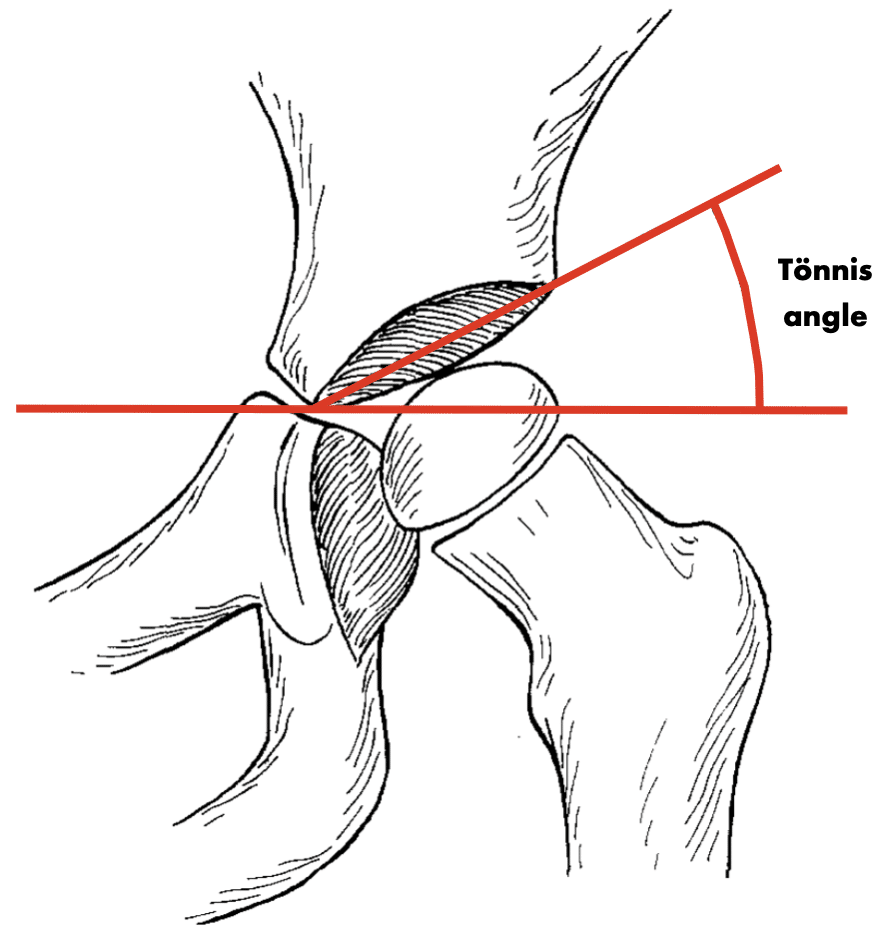
Measurement of the Tönnis angle
Hilgenreiner line is drawn through the lower lateral edges of the ilia at the triradiate cartilages. From this medial acetabular point, a second line is drawn along the sclerotic acetabular roof to the superior lateral acetabular rim. The angle between the two is the acetabular index (AC angle). If the lateral roof is rounded or double-contoured because of pelvic position, Tönnis advised using the true superior rim rather than simply the lowest projected contour.
History of the Tönnis angle
1908 – Michael Horváth described a radiographic inclination angle of the acetabular roof (Neigungswinkel des Pfannendaches). Rather than using a general horizontal reference, he took the horizontal limb of the Y-cartilage, or a line through the corresponding radiographic gap, as the baseline. The second line extended from its lateral endpoint to the junction of the acetabular roof and ilium; where no distinct corner was present, a tangent to the convex acetabular roof was used.
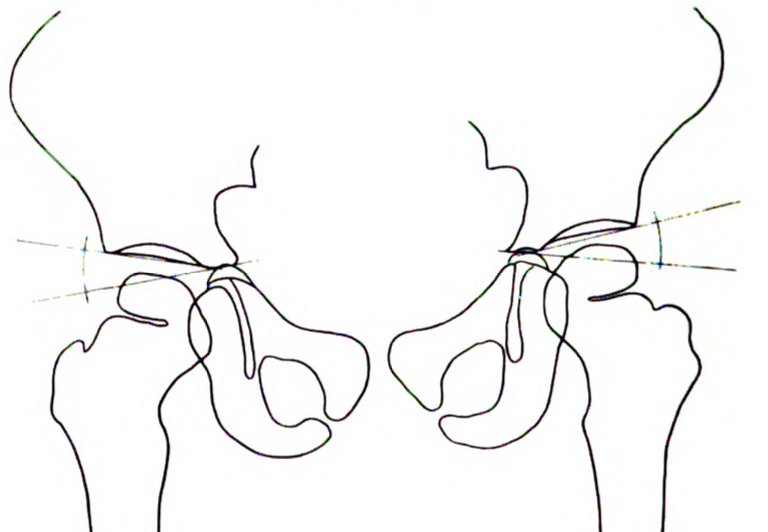
1925 – Heinrich Hilgenreiner incorporated the acetabular roof angle into a broader radiographic system for congenital hip dislocation. Unlike Horváth’s local Y-cartilage reference, Hilgenreiner used a single horizontal baseline connecting the two Y-cartilages, against which acetabular inclination was measured (Hilgenreiner line).
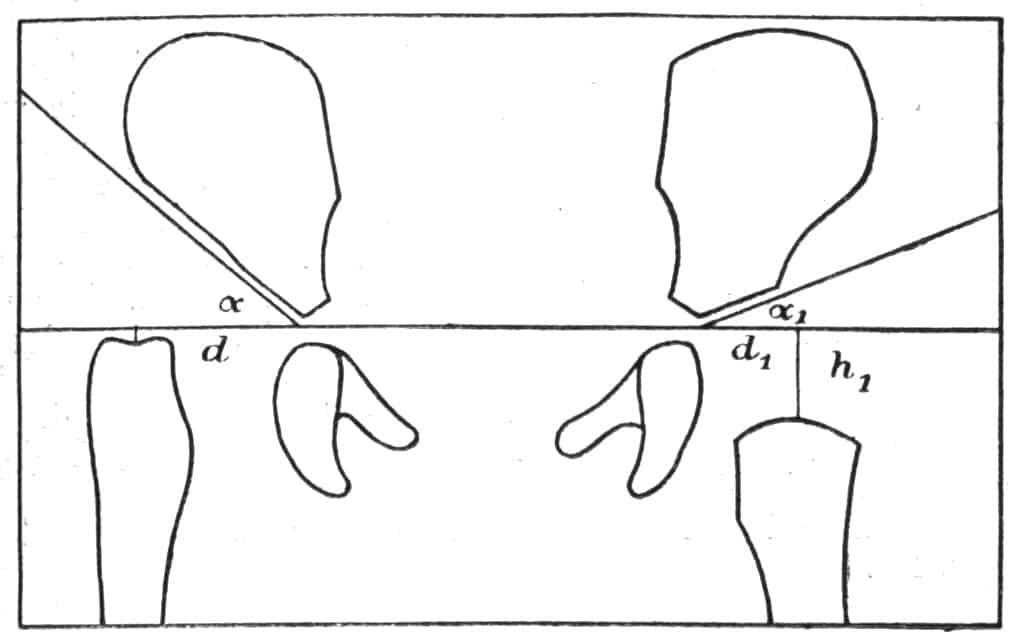
1968 – Dietrich Tönnis and D. Brunken investigated the acetabular roof angle in 2,294 paediatric hips. In which “Der Pfannendachwinkel wurde nach der Technik Hilgenreiners gemessen”, the acetabular roof angle was measured according to Hilgenreiner’s technique.
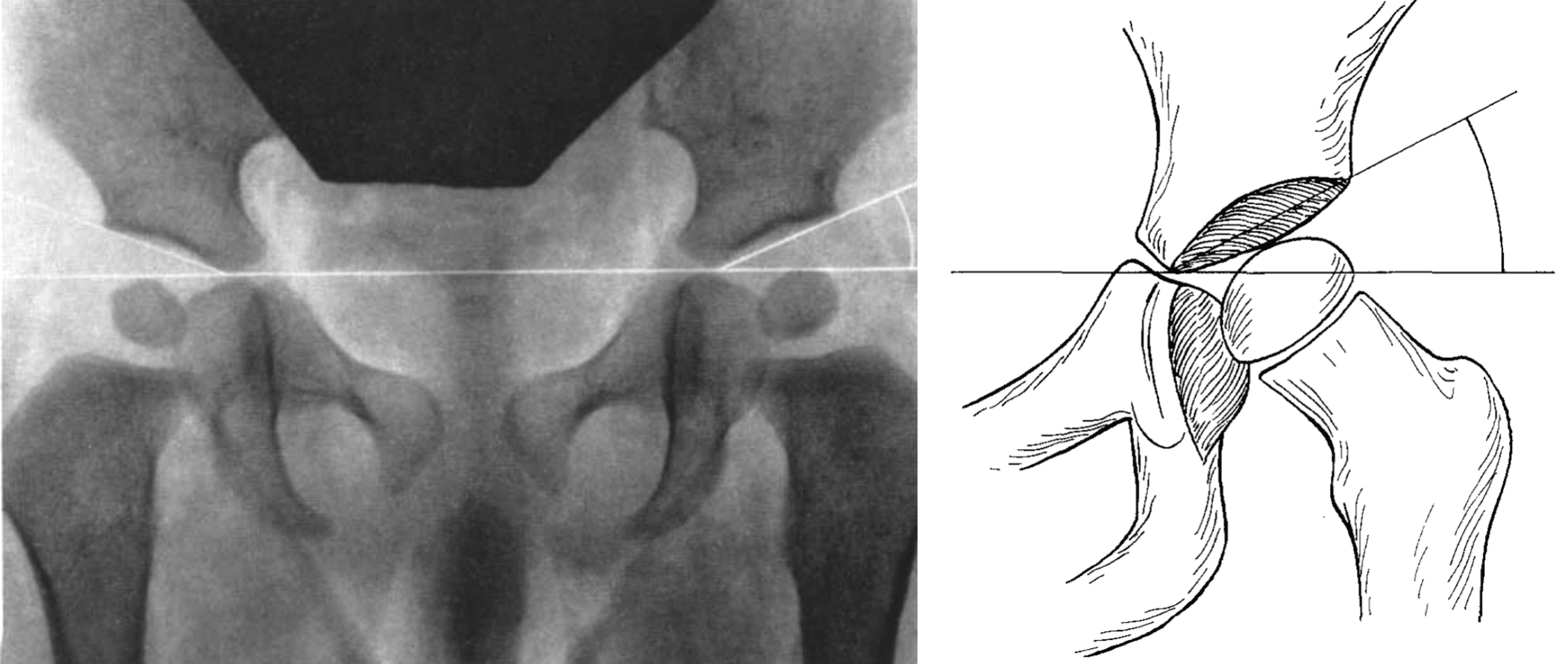
Their study examined age-related variation, the effects of pelvic rotation and tilt, and statistical limits separating normal from pathological acetabular development.
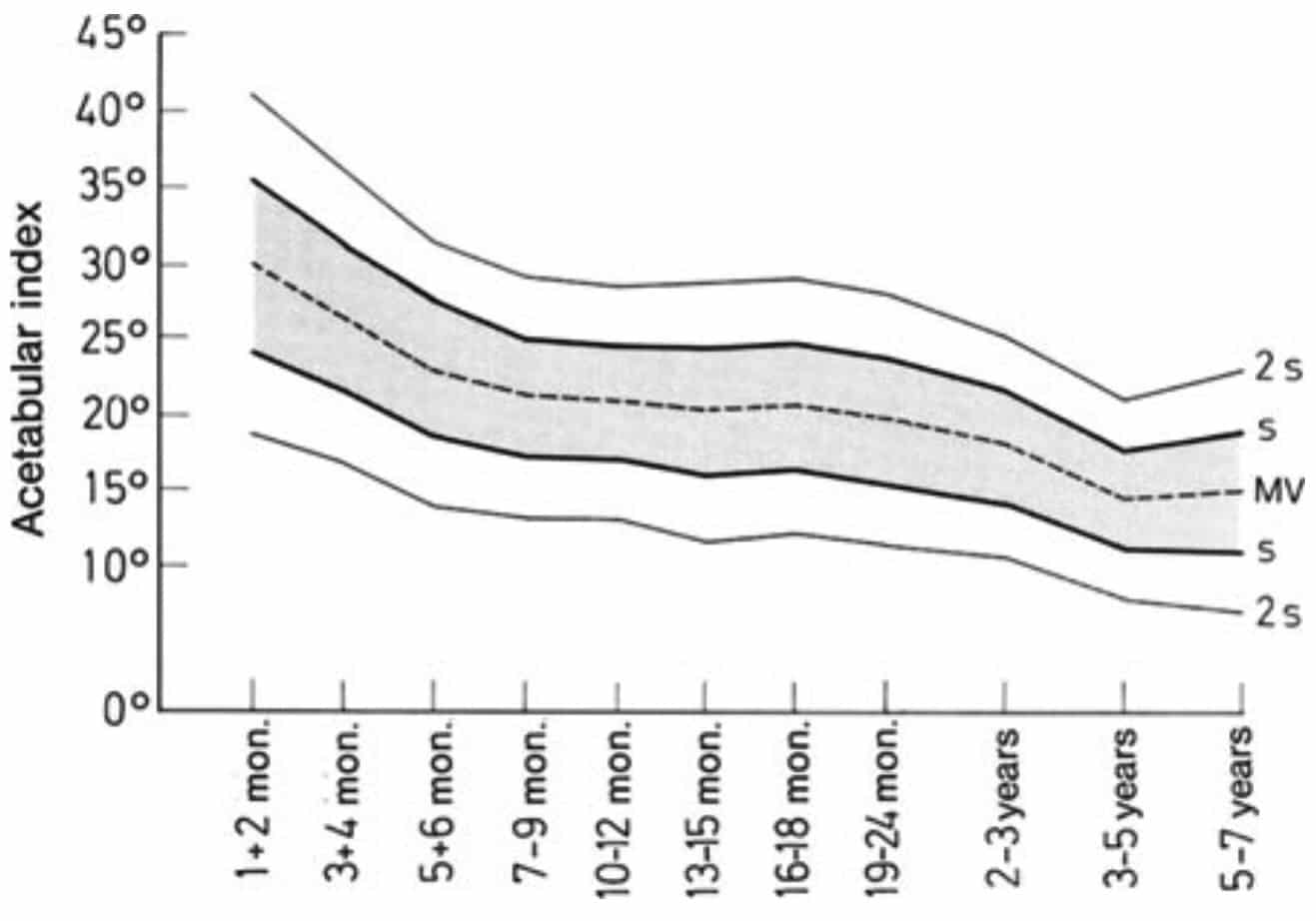
1976–1987 – Tönnis published Normal values of the hip joint for the evaluation of X-rays in children and adults in 1976. In his 1987 textbook Congenital Dysplasia and Dislocation of the Hip in Children and Adults, Tönnis still retained the name “Acetabular Index of Hilgenreiner (AC angle)”. He provided a detailed technical definition, defined the angles construction and provided age-, sex- and side-related reference ranges.
Associated Persons
- Heinrich Hilgenreiner (1870-1953) and the Hilgenreiner line
- Edward Warren Hine Shenton (1872–1955) and the Shenton line
- George Perkins (1892-1979) and the Perkins line
- Dietrich Tönnis (1927-2010) and the Tönnis angle
Alternative names
- Acetabular Index of Hilgenreiner
Eponymythology
An eponym for somebody else’s angle?
The measurement now commonly called the Tönnis angle evolved over several decades. First Horváth described an acetabular inclination angle referenced to the Y-cartilage in 1908. Then Hilgenreiner incorporated a similar roof angle into his bilateral pelvic measurement system in 1925. Finally Tönnis and Brunken established its age-related normal and pathological ranges in 1968.
Tönnis himself did not claim the geometric construction as his own. In his 1987 textbook he continued to call the measurement the “acetabular index of Hilgenreiner (AC angle)”. His contribution was to make the measurement standardised, reproducible and clinically interpretable.
References
Historical references
- Horvath M. Beitriige zur Pathologie und Therapie der angeborenen Hiiftverrenkung. Zeitschrift für orthopädische Chirurgie einschliesslich der Heilgymnastik und Massage, 1908; 22: 441-557.
- Hilgenreiner H. Zur Frühdiagnose und Frühbehandlung der angeborenen Hüftgelenkverrenkung. Medizinische Klinik 1925; 21: 1385-1388, 1425-1429
- Tönnis D, Brunken D. Eine Abgrenzung normaler und pathologischer Hüftpfannendachwinkel zur Diagnose der Hüftdysplasie. Auswertungen von 2294 Pfannendachwinkeln kindlicher Hüftgelenke. Arch Orthop Unfallchir. 1968;64(3):197-228.
- Tönnis D. Normal values of the hip joint for the evaluation of X-rays in children and adults. Clin Orthop Relat Res. 1976 Sep;(119):39-47.
- Tönnis D, Legal H, Graf R. Congenital Dysplasia and Dislocation of the Hip in Children and Adults. 1987
Eponymous term review
- Campbell SE. Radiography of the hip: lines, signs, and patterns of disease. Semin Roentgenol. 2005 Jul;40(3):290-319.
- Yeap PM, Budak MJ. The pelvic radiograph: lines, arcs and stripes. Singapore Med J. 2021 Jul;62(7):333-340.
- Bi AS, Carter C, Price AE, Litrenta J, Karamitopoulos M, Castañeda PG. A history of eponym usage in hip and pelvis radiography part 1: the paediatric hip. Hip Int. 2023 Mar;33(2):136-143.
- Bi AS, Ryan MK, Castañeda PG, Youm T. A history of eponym usage in hip and pelvis radiography part 2: the adult hip. Hip Int. 2023 Mar;33(2):144-151
- Kyle E, Cadogan M. Hip and pelvic lines and arcs. LITFL
eponymictionary
the names behind the name

MB BAO BCh Trinity College Dublin, MSc Clinical Data Analytics University of Galway. Junior doctor in Perth, doctoral researcher in MRI radiomics. Working towards radiology training.

BA MA (Oxon) MBChB (Edin) FACEM FFSEM. Emergency physician, Sir Charles Gairdner Hospital. Passion for rugby, medical history, medical education, and asynchronous learning #FOAMed evangelist. Editor-in-Chief and Webmaster of Life in the Fast lane, LITFL | On Call 4e| Eponyms | Books | Horology |