
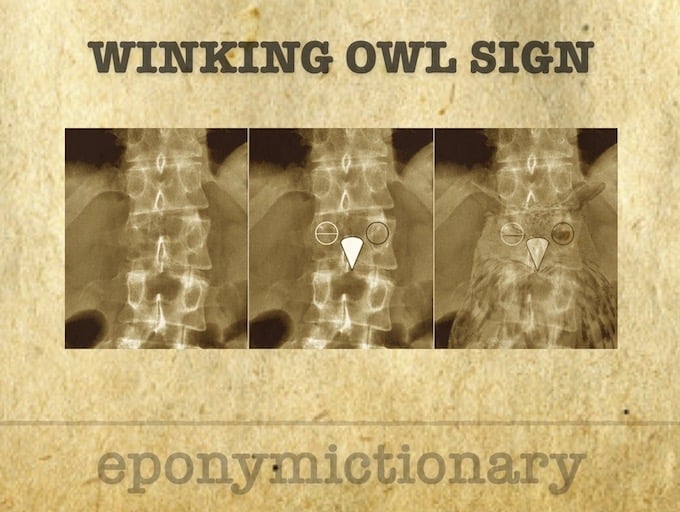
Winking owl sign
One of the first signs of vertebral metastases is disappearance of the pedicle on the AP X-ray. This is known as the 'absent pedicle' or 'winking owl sign'.


One of the first signs of vertebral metastases is disappearance of the pedicle on the AP X-ray. This is known as the 'absent pedicle' or 'winking owl sign'.

Throckmorton sign (John Thomas sign) where Penis Points to Pathology on X-ray. Tom Bentley Throckmorton (1885-1961) was an American neurologist

Segond fracture: Avulsion fracture (small) of the lateral surface of the lateral tibial condyle. Paul Ferdinand Segond (1851-1912) described 1879

Lindsay nails (half-and-half nails) is an apparent leukonychia of the proximal portion of the nail which is white with distal 20-60% reddish-brown

Cotton fracture (trimalleolar fracture) described in 1915 by Frederic Jay Cotton (1869-1939); fracture of the ankle that involving the lateral malleolus, medial malleolus and distal posterior aspect of the tibia (posterior malleolus).

Characteristic R wave notching seen in inferior leads in a large proportion of patients with ostium secundum ASD

Murphy’s sign is elicited in patients with acute cholecystitis by asking the patient to take in and hold a deep breath while palpating the right subcostal area. John Benjamin Murphy (1903)

Williams-Beuren syndrome: Generalized disorder characterized by unusual facies, abnormal behavioral abilities, cardiovascular anomalies, especially supravalvular aortic stenosis (SVAS), renal and other abnormalities
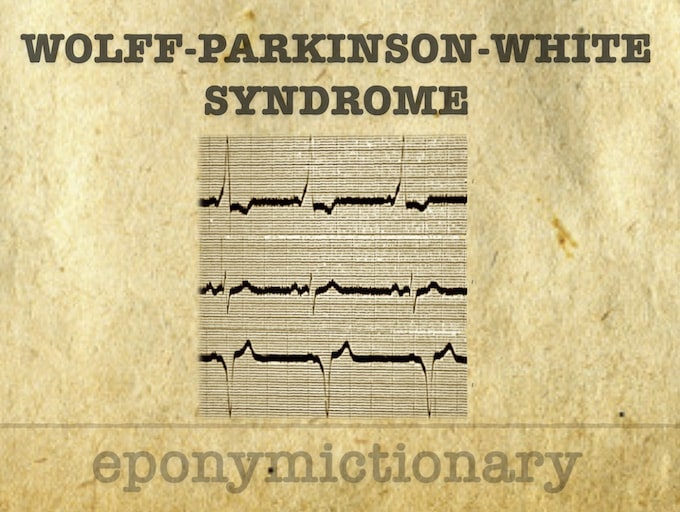
Wolff-Parkinson-White (WPW) Syndrome is a combination of the presence of a congenital accessory pathway and episodes of tachyarrhythmia.

Schamroth sign. Simple sign to determine the presence of finger clubbing. One of the earliest signs of clubbing is obliteration of the Schamroth 'window'.
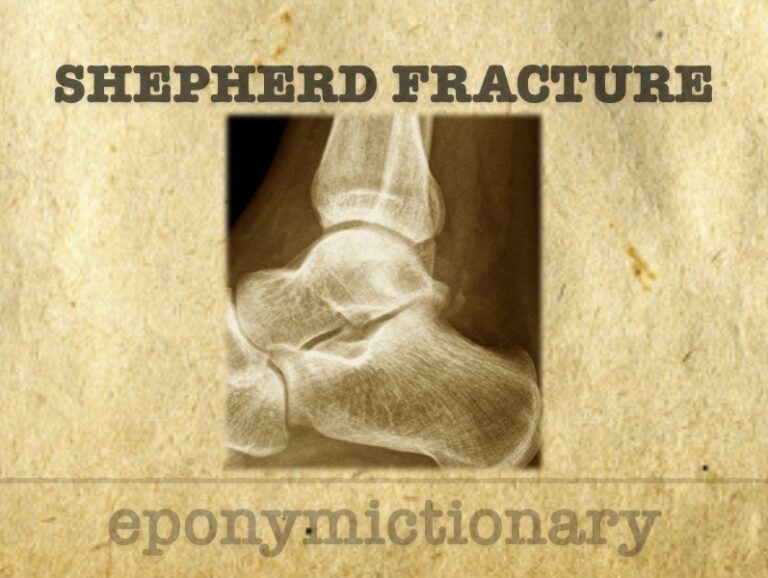
Sherpherd fracture: Posterior talar process fracture with injury to the lateral tubercle caused by inversion or extreme equinus (1882)

Cedell fracture (1974): Posterior talar process fracture with injury to the posteromedial tubercle caused by forced dorsiflexion and pronation