
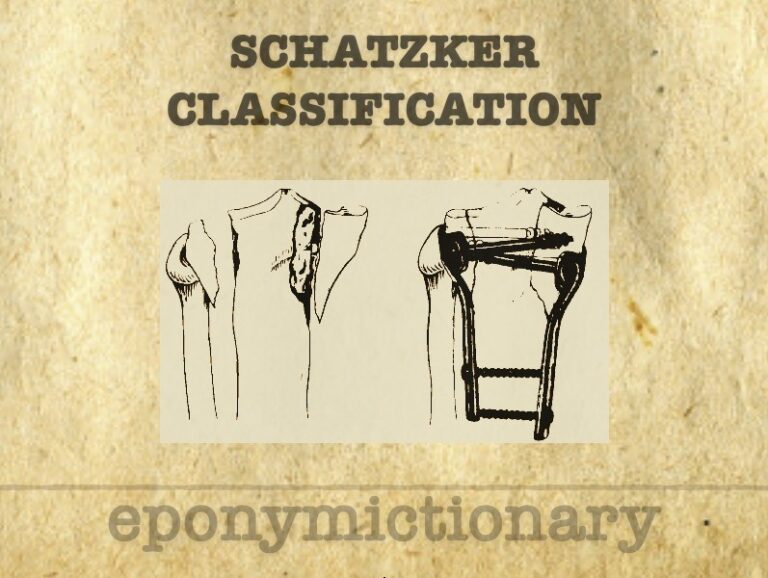
Schatzker classification of tibial plateau fractures
The Schatzker classification system divides tibial plateau fractures into six types. First described 1979 by Canadian surgeon Joseph Schatzker

The Schatzker classification system divides tibial plateau fractures into six types. First described 1979 by Canadian surgeon Joseph Schatzker

Salter-Harris classification of fractures describes injuries involving the epiphyseal plate of any bone. Described by Salter and Harris (Canada, 1963)
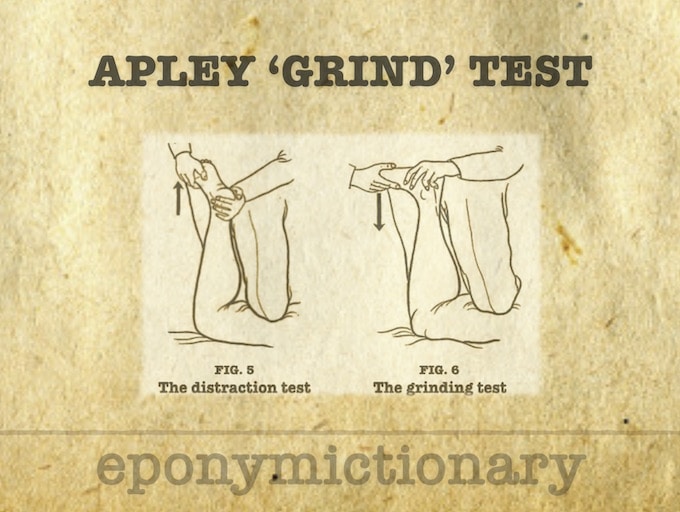
Apley Grind test (Apley Compression test) is a maneuver that is performed to evaluate for meniscus injury. 1947 by Alan Graham Apley (1914 - 1996)
Whipple procedure: Radical pancreatoduodenectomy for cancer of pancreas. Originally Codivilla (1898), then Kausch (1907) and Whipple (1934)
Henoch-Schonlein Purpura (HSP) or IgA Vasculitis, is the most common childhood vasculitis. There is a tetrad of the core clinical manifestations
Fox–Fordyce disease: A chronic itchy papular condition occurring in areas of the skin with apocrine glands especially the axilla of young women.
Katz-Wachtel phenomenon: Large biphasic QRS complexes (tall R waves + deep S waves) in V2-5. First described by Louis Nelson Katz in 1937
Description Biot respiration History 1876 – Biot studied patients with Cheyne–Stokes respiration at l’Hôtel-Dieu de Paris. In a 16-year old male with tuberculous meningitis he observed a previously undescribed pattern of breathing which he termed ‘rhythme meningitique‘. He found the…
The Trendelenburg position is credited to german surgeon Friedrich Trendelenburg, who created the position to improve surgical exposure of the pelvic organs during operations.The Trendelenburg position involves placing the patients head down, and elevating the feet.
Graves Ophthalmopathy: constellation of findings, apparent in 25-50% of patients with Graves disease. Robert Graves 1835
Graves disease: Autoimmune disease that affects the thyroid. A form of hyperthyroidism manifesting the triad of goitre, exophthalmos and pretibial myxoedema.
Möbius sign: Diagnostic test in patients with Morbus Basedow (Graves disease) - the inability to maintain ocular convergence in the presence of hyperthyroidism.