
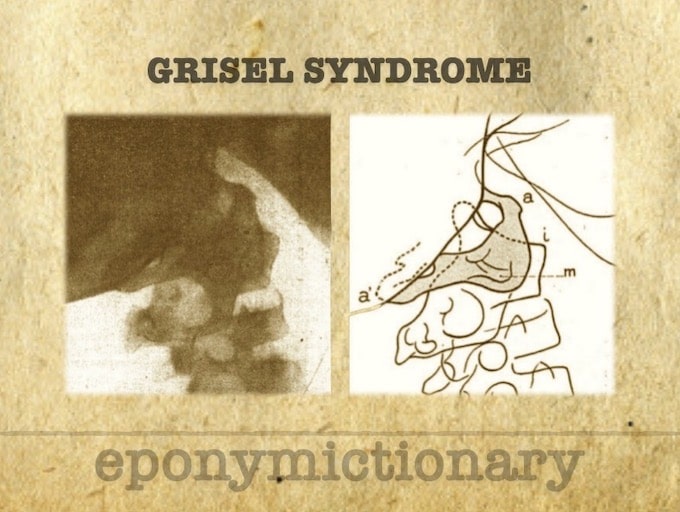
Grisel Syndrome
Spontaneous, nontraumatic rotatory subluxation of the atlantoaxial joint following peripharyngeal inflammation or ENT surgical procedures


Spontaneous, nontraumatic rotatory subluxation of the atlantoaxial joint following peripharyngeal inflammation or ENT surgical procedures

Legg-Calvé-Perthes disease (LCPD): avascular necrosis (AVN) of the proximal femoral head. The disease is usually insidious in onset and may occur after an injury to the hip.
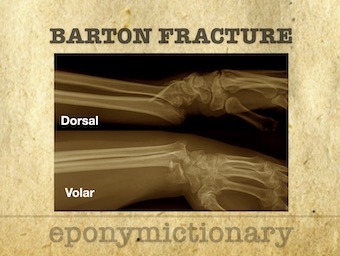
Barton fracture: Intra-articular distal radius fracture with radiocarpal joint subluxation. John Rhea Barton described Barton fracture in 1838.

Müller-Weiss syndrome , or spontaneous osteonecrosis of the tarsal navicular in adults, is a rare cause of chronic medial midfoot pain.

Joseph François Malgaigne (1806-1865) French Surgeon medical historian and critical thinker. Malgaine fracture (1847) unstable pelvic fracture

Osteopoikilosis is a autosomal dominant sclerosing bony dysplasia characterized by multiple benign benign sclerotic bone lesions (enostoses) that tend to localize in periarticular osseous regions

Simmonds-Thompson Test for evaluating achilles tendon rupture. Also known as the Simmonds Test (F.A. Simmonds) or Thompson Test (T. Campbell Thompson)

Hill-Sachs lesion (1940) Cortical depression of posterolateral head of the humerus related to impaction of the humeral head

José Luis Bado (1903-1977) was a Uruguayan surgeon who created the Bado Classification of Monteggia fractures in 1967 to define 4 Types

John Rhea Barton (1794-1871) was an American Orthopaedic Surgeon. Eponym: Barton fracture (1838). Intra-articular distal radius fracture.

Malgaigne fracture is an unstable fracture of the pelvis. First described in 1847 by French surgeon Joseph François Malgaigne (1806 – 1865)

Harold Arthur Hill (1901-1973) was an American radiologist who worked with Maurice David Sachs (1909-1987). Eponym: Hill-Sachs lesion (1940)