
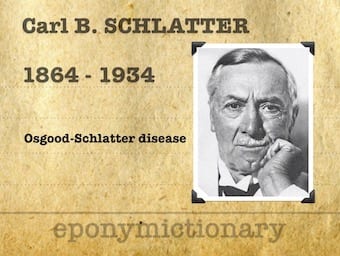
Carl B. Schlatter
Carl B. Schlatter (1864-1934) was a Swiss Surgeon. Krönlein's senior physician and first "trauma surgeon". Osgood-Schlatter disease in (1903)

Carl B. Schlatter (1864-1934) was a Swiss Surgeon. Krönlein's senior physician and first "trauma surgeon". Osgood-Schlatter disease in (1903)

Robert Bayley Osgood (1873–1956) American orthopedic surgeon. Described Osgood-Schlatter disease in 1903

Sir Robert Jones (1857-1933) was a Welsh General and Orthopaedic Surgeon and part time Roentgenologist. Eponym: Jones fracture (1902)

Jones Fracture : proximal diaphysis of the 5th metatarsal, distal to the tuberosity, without joint involvement. Sir Robert Jones (1857-1933) described 1902

September 2020 Adult Emergency Medicine Chest X-ray interpretation with Travis Barlock, MD and Breeanna Lorenzen MD

Gertrud Dina Schachenmann (1910 - 1997) was a Swiss pediatrician. Smith-Theiler-Schachenmann syndrome (1966)
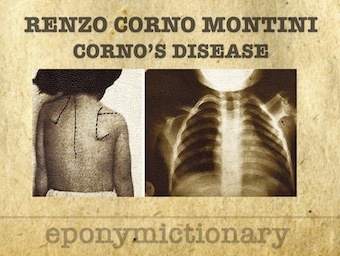
Renzo Corno Montini (1927 - 1965) was an Italian pediatric orthopedic surgeon. Corno's disease; familial form of Sprengel's deformity.

Maurice David Sachs (1909-1987) was an American radiologist who worked with Harold Arthur Hill (1901-1973). Eponym: Hill-Sachs lesion (1940)

Fox's sign: non-traumatic ecchymosis over the upper outer aspect of the thigh secondary to abdominal haemorrhage. First described by English surgeon John Adrian Fox in 1966
John Adrian Fox English surgeon. Eponym: Fox's sign (1966) non-traumatic ecchymosis upper outer thigh with abdominal haemorrhage

Dislocation of the foot through the talonavicular and the calcaneocuboid joints (Chopart joint) with associated fractures. François Chopart

Lisa Welander (1909 - 2001) was a Swedish neurologist. Sweden's first professor of neurology. Welander distal myopathy; Wohlfart-Kugelberg-Welander syndrome