


Sharp angle
Sharp angle, or acetabular angle, is a radiographic measure of overall acetabular inclination on an AP pelvis radiograph.
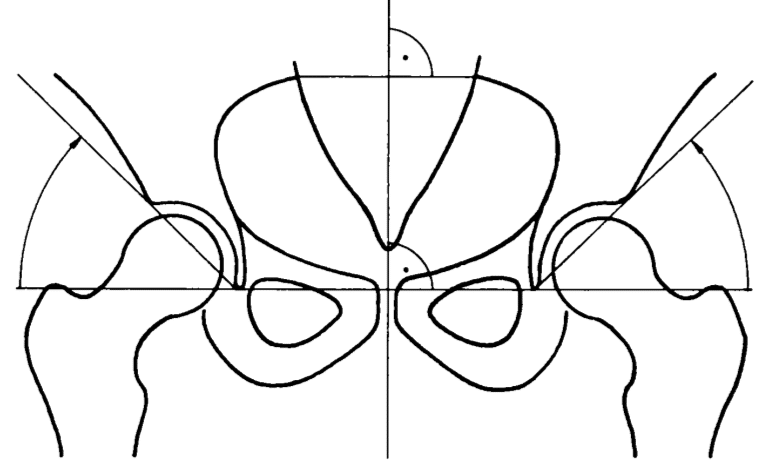
The Sharp angle is measured from the inferior tip of the pelvic teardrop (U-figure). A horizontal reference is drawn through the corresponding points of both teardrops, and a second line extends from the inferior teardrop to the lateral edge of the acetabular roof. The angle between these lines represents acetabular inclination.
Increasing values indicate a steeper acetabular roof and may support the diagnosis of acetabular dysplasia.
Ian K. Sharp systematically described and evaluated the measurement in 1961. However, Dietrich Tönnis (1927–2010) later attributed an equivalent construction to Karl Ullmann, presented in 1938, and referred to the measurement as the Ullmann–Sharp angle.
History
1938 – K. Ullmann presented work on radiographic assessment of the bony acetabular roof at the 33rd Congress of the German Orthopaedic Society with proceedings were published in 1939. Ullmann measured transverse acetabular inclination from the lowest point of the acetabular teardrop or acetabular notch, between a horizontal reference and a line to the superior acetabular rim. Ullmann as regarding approximately 45° as the upper limit of acetabular inclination in younger subjects.
1961 – Ian K. Sharp, working in Hull, independently described and systematically evaluated what he called the acetabular angle. Sharp defined a measure of the acetabulum itself, independent of femoral-head position. He considered Wiberg’s CE angle vulnerable to error when
- a deformed femoral head made its centre difficult to locate;
- subluxation or joint-space loss altered the CE angle;
- subluxation of the opposite hip distorted Wiberg’s bilateral reference axis.
Sharp defined the landmarks as the inferior tip of the U-figure (“pelvic tear drop”) and the lateral edge of the acetabular roof, with the line joining the two U-figures providing the horizontal reference. He also tested pelvic tilt and rotation and found relatively small changes in the measured angle, supporting the reproducibility of the construction.
Sharp examined 200 hips in 100 adults aged over 60 years without radiographic osteoarthritis, reasoning that a normal hip should remain satisfactory throughout life. He reported:
- 33–38° – usual normal range
- 39–42° – upper end of normal
- 42–47° – significance uncertain in his original series
- 47° – demonstrated in an example of congenital subluxation
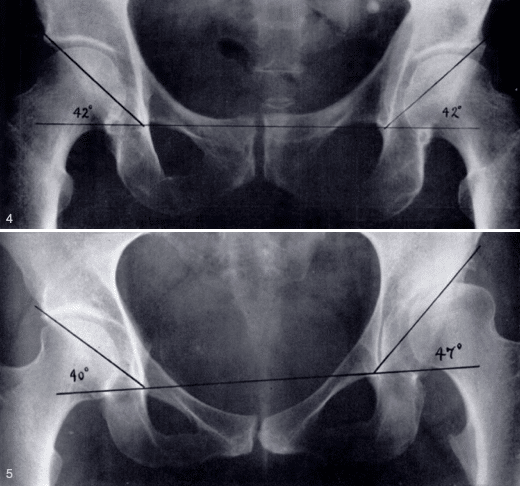
Fig 4: morphologically normal hips with acetabular angles of 42°, illustrating the upper end of Sharp’s normal series; adequate acetabular depth still provides femoral-head coverage.
Fig 5: congenital hip subluxation with an acetabular angle of 47° and disruption of Shenton line. Sharp emphasised that the measurement describes acetabular inclination rather than acetabular depth.
1974 – Stulberg and Harris incorporated the acetabular angle into a broader radiographic assessment of acetabular dysplasia alongside the CE angle, acetabular depth and roof configuration. Their normal series gave mean Ullmann–Sharp values around 33–35°, with ranges extending to approximately 41°.
1987 – Dietrich Tönnis described the measurement as the acetabular angle of Ullmann and Sharp, distinguishing it from measurements of acetabular depth. He emphasised its usefulness for assessing overall acetabular inclination after fusion of the triradiate cartilage and regarded values around 43° or greater as suspicious for dysplasia in adolescents and adults.
Modern usage: English-language literature has largely retained the names Sharp angle and acetabular angle, while Ullmann’s name has largely disappeared. Contemporary descriptions generally retain the horizontal inter-teardrop reference and the line to the lateral acetabular roof.
Associated Persons
- Alban Köhler (1874–1947) and the Köhler teardrop
- Gunnar Wiberg (1902–1988) and the centre-edge angle of Wiberg
- Ian K Sharp
- Dietrich Tönnis (1927-2010)
Alternative names
- Acetabular angle
- Sharp’s angle
- Ullmann–Sharp angle
Eponymythology
Sharp’s 1961 paper provides a clear, detailed and experimentally tested description of the acetabular angle and established its normal adult range in English-language orthopaedics.
However, Tönnis later attributed essentially the same construction to Ullmann in 1938 and consistently referred to it as the Ullmann–Sharp angle. Until Ullmann’s original report is examined, it is unclear whether Sharp independently re-described an existing measurement, modified it, or simply provided the first widely adopted English-language validation.
Modern literature has largely retained Sharp angle, while Ullmann’s name has almost disappeared.
References
Historical references
- Ullmann K. Zur Frage der röntgenologischen Beurteilung des knöchernen Pfannendachs mit weiteren Ergebnissen der Röntgenstammbaumforschung. Verhandlungen der Deutschen Gesellschaft für Orthopädie, 33. Kongress (1938); Zeitschrift fur Orthopadie und ihre Grenzgebiete 1939;69:268–271 (Beilageheft).
- Sharp IK. Acetabular dysplasia: the acetabular angle. J Bone Joint Surg Br. 1961;43-B(2):268–272.
- Zippel H. Untersuchungen zur Normalentwicklung der Formelemente am Hiiftgelenk im Wachstumsalter. Beiträge zur Orthopädie und Traumatologie 1971; 18: 225-269
- Stulberg SD, Harris WH. Acetabular dysplasia and development of osteoarthritis of hip. In: The hip. Proceedings of the second open scientific meeting of the hip society, 1974: 82-92
- Tönnis D. Normal values of the hip joint for the evaluation of X-rays in children and adults. Clin Orthop Relat Res. 1976 Sep;(119):39-47.
- Tönnis D, Heinecke A, Nienhaus R, Thiele J. Lässt sich das Auftreten von Arthrose, Schmerz und Bewegungseinschränkung des Hüftgelenkes bei Hüftdysplasie vorausberechnen? Z Orthop Ihre Grenzgeb. 1979 Oct;117(5):808-15.
- Tönnis D, Legal H, Graf R. Congenital Dysplasia and Dislocation of the Hip in Children and Adults. 1987
- Kyle E, Cadogan M. Hip and pelvic lines and arcs. LITFL
eponymictionary
the names behind the name

MB BAO BCh Trinity College Dublin, MSc Clinical Data Analytics University of Galway. Junior doctor in Perth, doctoral researcher in MRI radiomics. Working towards radiology training.

BA MA (Oxon) MBChB (Edin) FACEM FFSEM. Emergency physician, Sir Charles Gairdner Hospital. Passion for rugby, medical history, medical education, and asynchronous learning #FOAMed evangelist. Editor-in-Chief and Webmaster of Life in the Fast lane, LITFL | On Call 4e| Eponyms | Books | Horology |