

Charles J. Aldrich
Charles John Aldrich (1861-1908) American neurologist. Provided early description of Mees lines he termed 'Leuconychia striata arsenicalis transversus'

Charles John Aldrich (1861-1908) American neurologist. Provided early description of Mees lines he termed 'Leuconychia striata arsenicalis transversus'
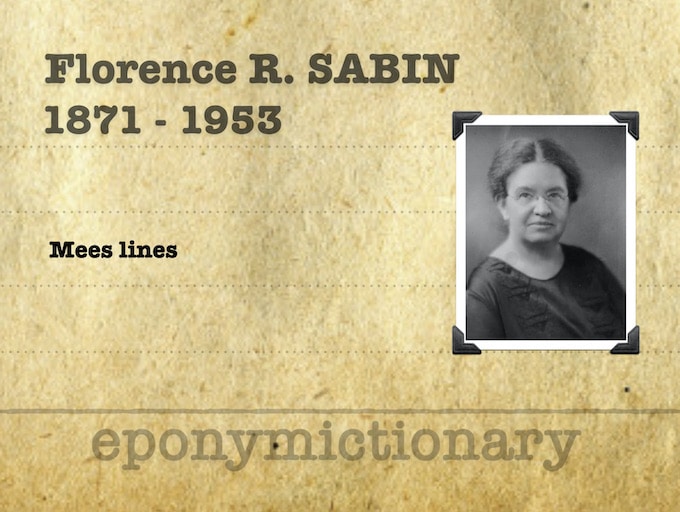
Florence Rena Sabin (1871-1953) American anatomist and medical researcher. Early description (1900) of Mees lines of the fingernails secondary to arsenic poisoning

Comms Lab 18: Communication Skills for Difficult Conversations - The Actual Skills. Indexed toolbox of communication skills for difficult conversations.

Stevens-Johnson syndrome is an immunological skin conditions, often secondary to drugs or infection.

Frank Chambliss Johnson (1894 – 1934) was an American pediatrician. Along with Albert Mason Stevens (1884 – 1945), is eponymously affiliated with Stevens-Johnson syndrome

Albert Mason Stevens (1884 – 1945) was an American surgeon. Eponym Stevens-Johnson syndrome (with Frank Chambliss Johnson)

Terry's nails are a type of apparent leukonychia, characterized by ground glass opacification of almost the entire nail, with a narrow band of normal, pink nail bed at the distal border, and often with obliteration of the lunula.
Heart HQ - Episode 14: Happy New Year. As the year draws to a close, we reflect on the year that was and look ahead to a busy 2022.

Fracture of the anterolateral tibial epiphysis commonly seen in adolescents. (Salter-Harris III tibial fracture) aka Tillaux-Chaput fracture.
Biography Medical Eponyms Lovibond angle (profile sign) [1938] In 1938, Lovibond was among the first to offer a criteria for the diagnosis of finger clubbing. He defined the ‘profile sign’ of the thumb (Lovibond’s angle), as the angle made by…
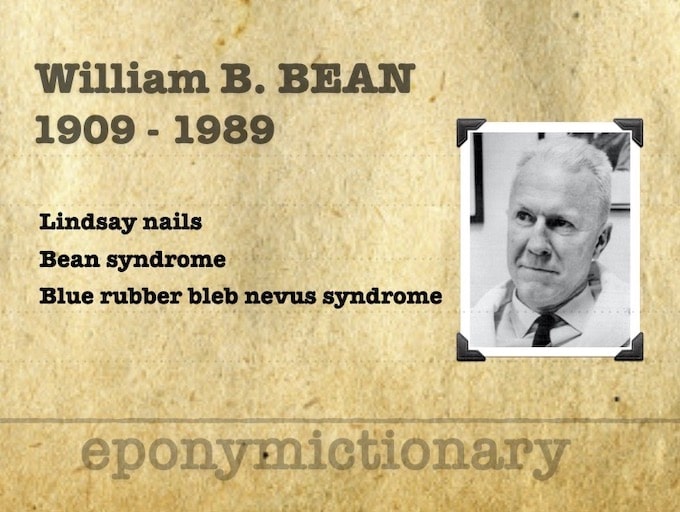
William Bennett Bean (1909-1989) was an American physician, medical historian. Bean syndrome (1958) [Blue rubber bleb nevus syndrome] and spider naevi
The Osborn wave (J wave) is a positive deflection at the J point (negative in aVR and V1). It is usually most prominent in the precordial leads and most commonly associated with hypothermia.