


Know Your Lines
Adult and paediatric radiograph lines, angles and measurements
The fracture is not always the hardest part to see. Sometimes it is the line you did not draw.
Subtle musculoskeletal injury may be revealed not by an obvious cortical break, but by a disrupted arc, altered angle, widened interval or loss of normal alignment. The difficulty is often remembering which measurement applies, how it should be drawn and what constitutes an abnormal result.
The Know Your Lines quick-reference guides bring commonly used adult and paediatric radiographic lines, angles, ratios, signs and classifications together in two bedside resources. They are designed to support a systematic review of trauma radiographs and help identify abnormalities that may otherwise be overlooked.
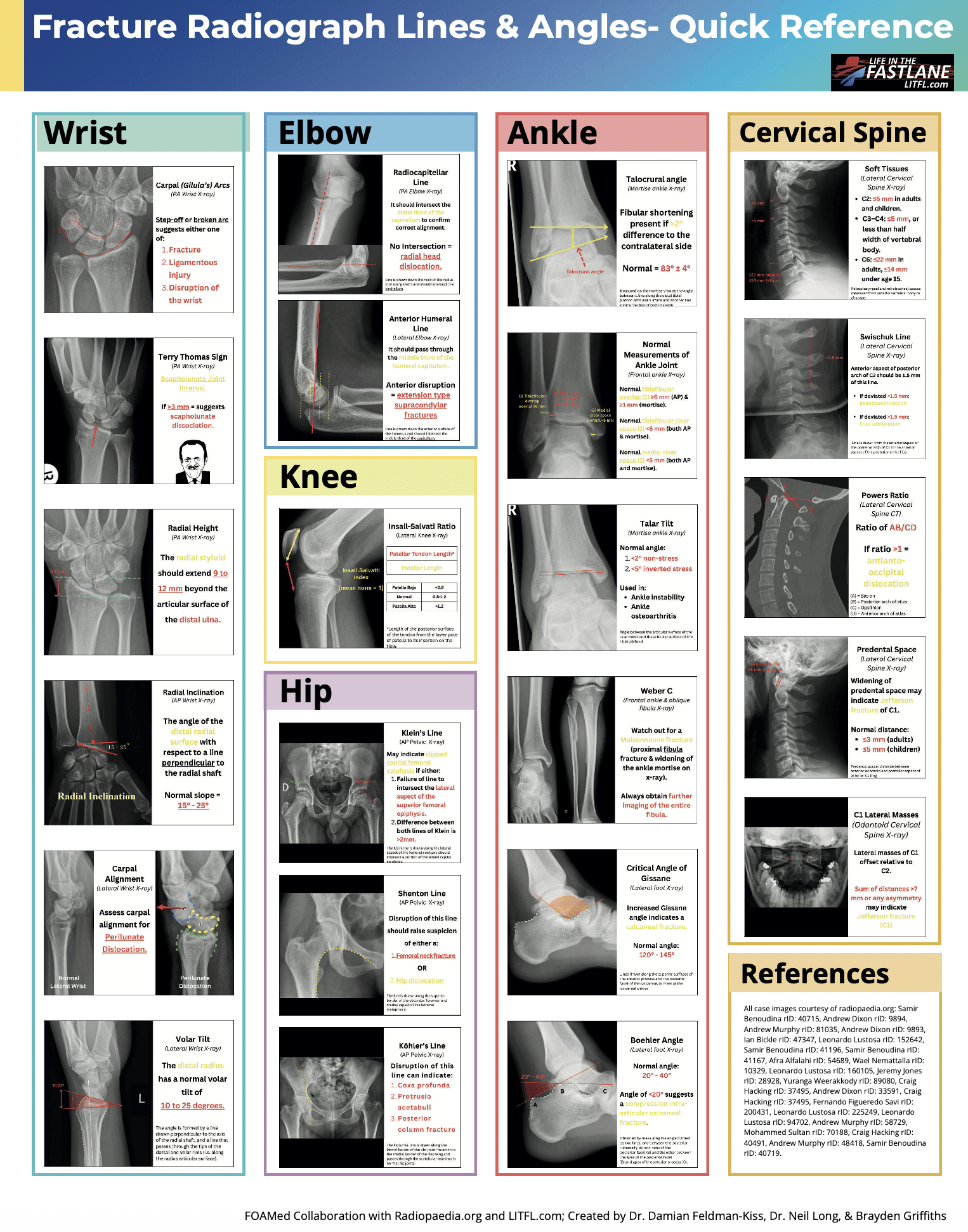
The adult guide covers the wrist, elbow, knee, hip, ankle and cervical spine. It includes carpal alignment, elbow relationships, patellar height, hip alignment, ankle measurements, calcaneal angles and cervical spine assessment.
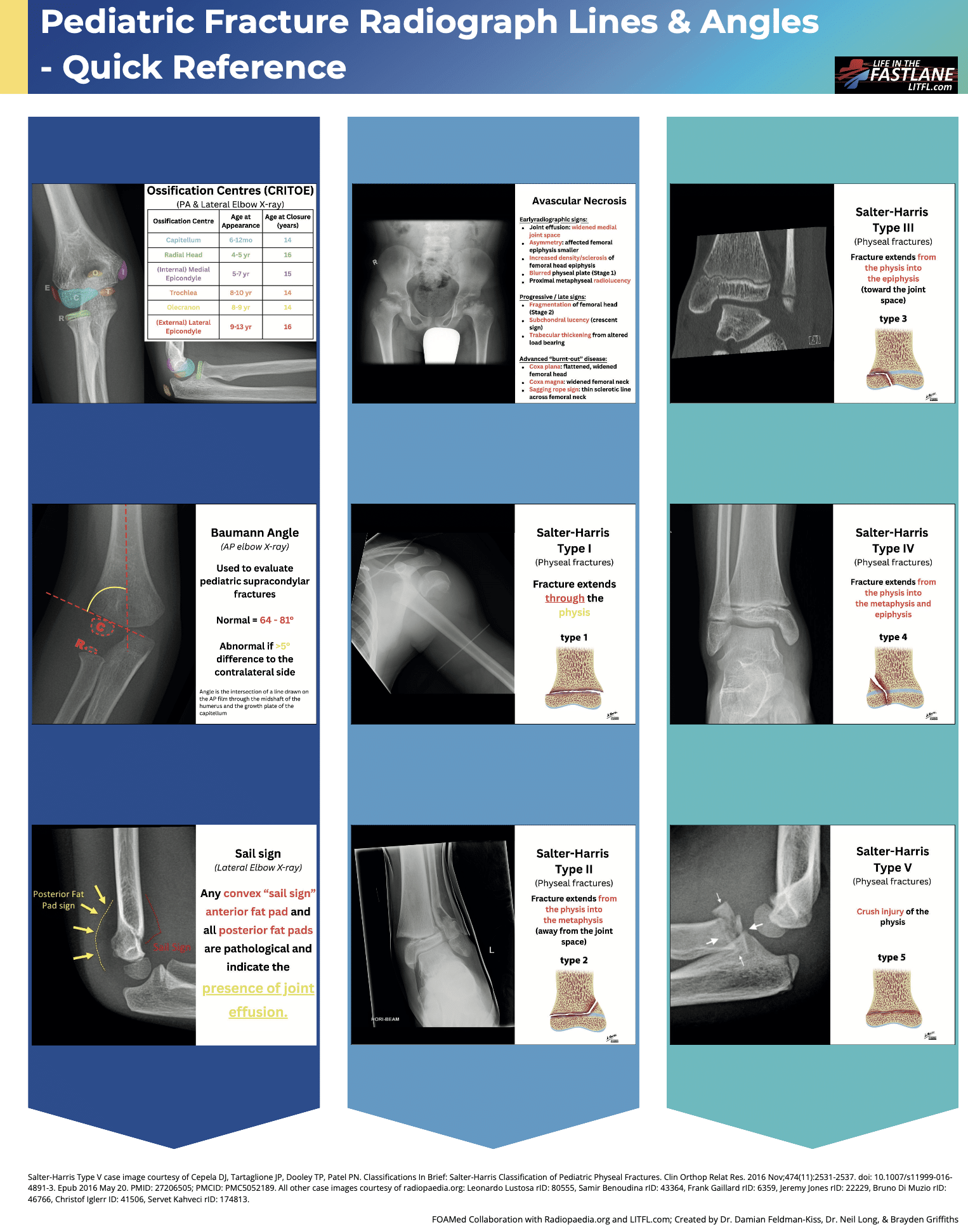
The paediatric guide focuses on age-dependent interpretation, including elbow ossification centres, the Baumann angle, elbow fat-pad signs, radiographic features of avascular necrosis and the Salter–Harris classification of physeal injuries.
These guides are rapid clinical prompts rather than comprehensive imaging rules. Measurements may be affected by projection, positioning, skeletal maturity and anatomical variation. Where appropriate, findings should be interpreted alongside the clinical examination, comparison views, previous imaging and formal radiology review.
A collaborative FOAMed project
Know Your Lines was developed by Drs Damian Feldman-Kiss, Brayden Griffiths and Neil Long, with radiographic images provided through Radiopaedia.org and LITFL. The aim is to make commonly used radiographic relationships easier to find, apply and teach at the bedside.
Adult fracture radiograph lines and angles
Paediatric fracture radiograph lines and angles
References and image acknowledgements
- Basic Fracture Treatment [link to Customisable PDF]
- Adult and paediatric radiograph lines, angles and measurements [Reference List]
Eponymous terms referenced in the posters
- Terry-Thomas sign named for English actor Terry-Thomas (1911–1990), whose dental diastema resembled widening of the scapholunate interval.
- Köhler line, the ilioischial line, associated with German radiologist Alban Köhler (1874–1947)
- Danis–Weber classification originally described by Belgian surgeon Robert Danis (1880-1962) and later modified and popularised by Swiss orthopaedic surgeon Bernhard Georg Weber (1927-2002).
- Maisonneuve fracture associated with French surgeon Jacques Gilles Maisonneuve (1809–1897).
- Critical angle of Gissane associated with Australian-born British trauma surgeon William Gissane (1898–1981).
- Böhler angle associated with Austrian trauma surgeon Lorenz Böhler (1885-1973)
- Jefferson fracture associated with British neurosurgeon Sir Geoffrey Jefferson (1886–1961). LITFL already has the fracture and biography.
- Salter–Harris classification introduced by Canadian orthopaedic surgeons Robert Bruce Salter (1924–2010) and W. Robert Harris (1922–2005).
- Gilula carpal arcs described in 1979 by American musculoskeletal radiologist Louis A. Gilula (1942–2014
- Baumann angle defined by Swiss surgeon Ernst Baumann (1890-1978).
- Klein line devised by American orthopaedic surgeon Armin Klein (1892–1954) in 1952.
- Shenton line described by English radiologist Edward Warren Hine Shenton (1872–1955) in 1902.
- Swischuk line — associated with American paediatric radiologist Leonard E. Swischuk (1937–2021), who published its use in distinguishing physiological from pathological upper cervical displacement in 1977.
- Insall–Salvati ratio. John Insall and Eduardo Salvati, described their method of evaluating patellar position in 1971.
- Powers ratio described by American radiologist Barry Powers and colleagues in 1979 for anterior atlanto-occipital dislocation.
Trauma Library
Injury database

Dr Neil Long BMBS FACEM FRCEM FRCPC. Emergency Physician at Kelowna hospital, British Columbia. Loves the misery of alpine climbing and working in austere environments (namely tertiary trauma centres). Supporter of FOAMed, lifelong education and trying to find that elusive peak performance.