


Basic Fracture Treatment
A customisable emergency department reference
Emergency fracture management does not end with recognising and immobilising the injury. Clinicians must also decide whether specialist review is required, where that review should occur and how urgently it should be arranged. These pathways vary considerably between hospitals.
Some departments have dedicated fracture clinics. Others rely on community orthopaedics, plastic surgery, sports medicine or primary care. Certain injuries require urgent assessment within days, while many uncomplicated fractures can be managed without routine specialist follow-up.
The Basic Fracture Treatment Quick Reference brings common fractures and related musculoskeletal injuries together on a single poster, with radiographic examples, initial immobilisation advice and important treatment cautions. The interactive PDF includes fillable dropdown and free-text fields so that each department can add its own follow-up destination, timeframe and local instructions.
This resource was developed collaboratively by Dr Damian Feldman-Kiss, Dr Brayden Griffiths and Dr Neil Long. Radiographic images were provided through Radiopaedia.org, with selected paediatric scaphoid and medial condyle images supplied by LITFL.
Open the interactive PDF to customise your department’s fracture follow-up pathways.
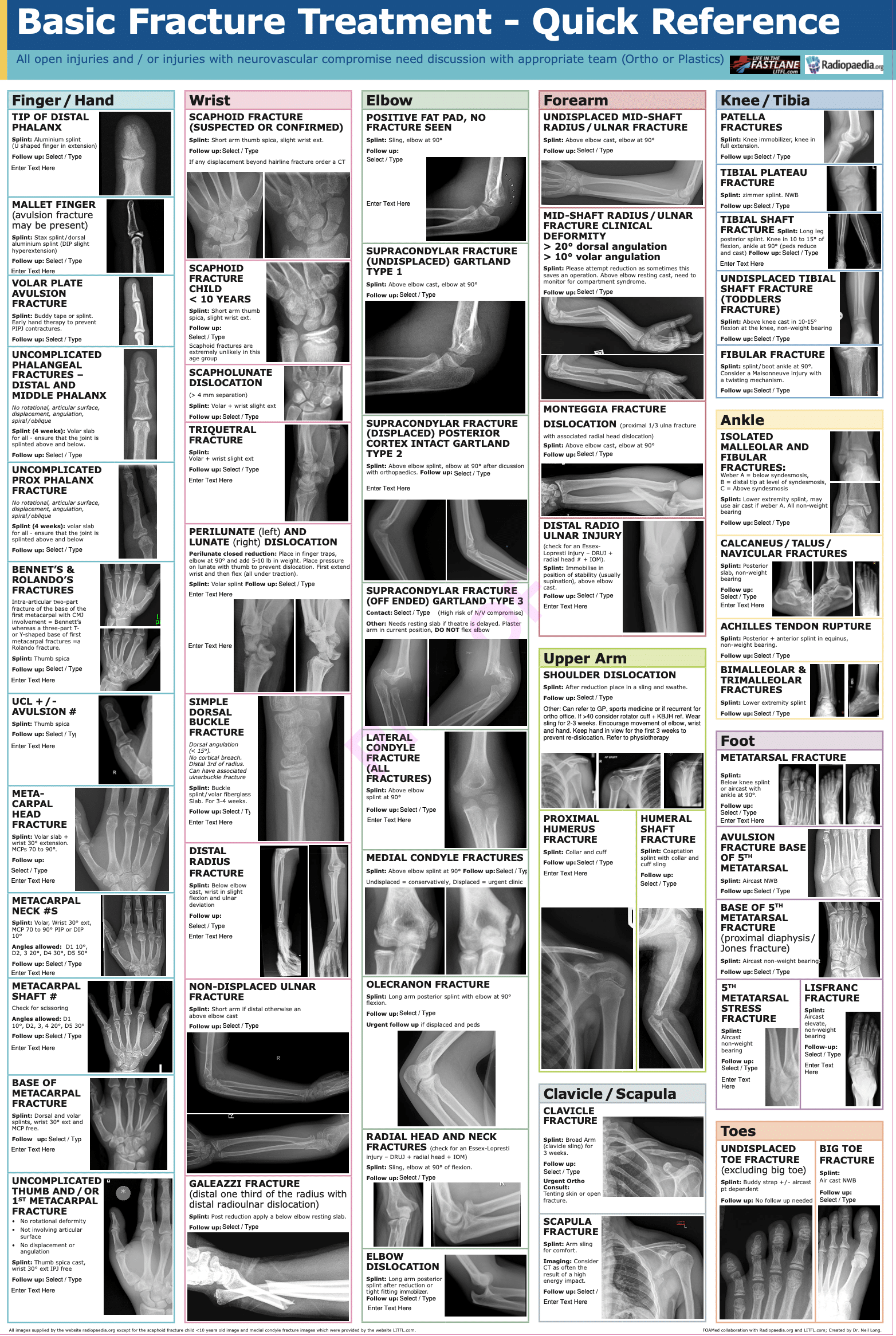
Image acknowledgements: Radiographic images were supplied through Radiopaedia.org, except for the paediatric scaphoid and medial condyle fracture images provided by LITFL. Full image references and attribution are included in the accompanying reference list.
Further reading
- Basic Fracture Treatment [Customisable PDF]
- Basic Fracture Treatment [Reference List]
- Adult and paediatric radiograph lines, angles and measurements
Eponymous terms referenced in the poster
- Bennett fracture associated with Irish surgeon Edward Hallaran Bennett (1837–1907), who described the unstable two-part intra-articular fracture-dislocation of the base of the first metacarpal in 1882
- Rolando fracture associated with Italian surgeon Silvio Rolando (1873–1949), who described the comminuted T- or Y-shaped intra-articular fracture of the first metacarpal base in 1910.
- Galeazzi fracture-dislocation described by Italian orthopaedic surgeon Riccardo Galeazzi(1866–1952). He reported 18 cases of radial shaft fracture with distal radioulnar joint disruption in 1934. The injury pattern had been described earlier by Sir Astley Cooper.
- Monteggia fracture-dislocation associated with Italian surgeon Giovanni Battista Monteggia (1762–1815), who described fracture of the proximal ulna with radial head dislocation in 1814.
- Essex–Lopresti injury associated with British orthopaedic surgeon Peter Gordon Lawrence Essex-Lopresti (1916–1951), who described the combination of radial head fracture, interosseous membrane disruption and distal radioulnar joint dislocation in 1951.
- Gartland classification introduced by American orthopaedic surgeon John J. Gartland (1918-2016), who published his three-part classification of extension-type paediatric supracondylar humeral fractures in 1959.
- Jones fracture described by Welsh orthopaedic surgeon Sir Robert Jones (1857–1933) in 1902 after sustaining the injury himself while dancing
- Lisfranc injury associated with French surgeon Jacques Lisfranc de Saint-Martin (1787–1847), whose 1815 description of amputation through the tarsometatarsal articulation gave his name first to the joint and later to injuries disrupting it.
- Danis–Weber classification originally described by Belgian surgeon Robert Danis (1880-1962) and later modified and popularised by Swiss orthopaedic surgeon Bernhard Georg Weber (1927-2002).
- Maisonneuve fracture associated with French surgeon Jacques Gilles Maisonneuve (1809–1897).
- Stack splint — associated with British hand surgeon Hugh Graham Stack, who published extensively on mallet finger and later described a modified splint for its treatment
- Achilles tendon is also referenced in the poster, but is a mythonym derived from the Greek hero Achilles rather than a medical eponym
Trauma Library
Injury database

Dr Neil Long BMBS FACEM FRCEM FRCPC. Emergency Physician at Kelowna hospital, British Columbia. Loves the misery of alpine climbing and working in austere environments (namely tertiary trauma centres). Supporter of FOAMed, lifelong education and trying to find that elusive peak performance.